Welcome to the ninth installment of my blog about Gematria, the Merkabah and the birth of the Alephbet. Today I’ll be looking at how biblical gematria was adapted to the Greek script, and giving some examples from the New Testament.
There have been few writers who specialize on the subject of gematria, so it suffers from having too few references, with the consequence that insufficient research by these writers can be given too much weight. For instance, the writer Kieran Barry (1999) opined that gematria had Greek origins, which is completely untrue as I’ll demonstrate.
When Stephen J. Lieberman (1987) published his excellent paper ‘A Mesopotamian Background for the So-Called Aggadic ‘Measures’ of Biblical Hermeneutics?‘ he made it quite clear that Jewish gematria is as different from the Mesopotamian practice of “aru” as chalk is from cheese.
Likewise, when it comes to the Greek version of gematria; called Isopsephy, researchers have had exactly the same problem; to date they have been analyzing the texts of the New Testament using the wrong number set. The correct number set is a transliteration of biblical gematria:
Biblical gematria;
א 1 ב 2 ג 3 ש 3 ד 4 ת 4 ה 5 ו 6 ז 7 ח 8 ט 9 י 10 כ 20
ל 30 מ 40 נ 50 ס 60 ע 70 פ 80 צ 90 ק 100 ר 200
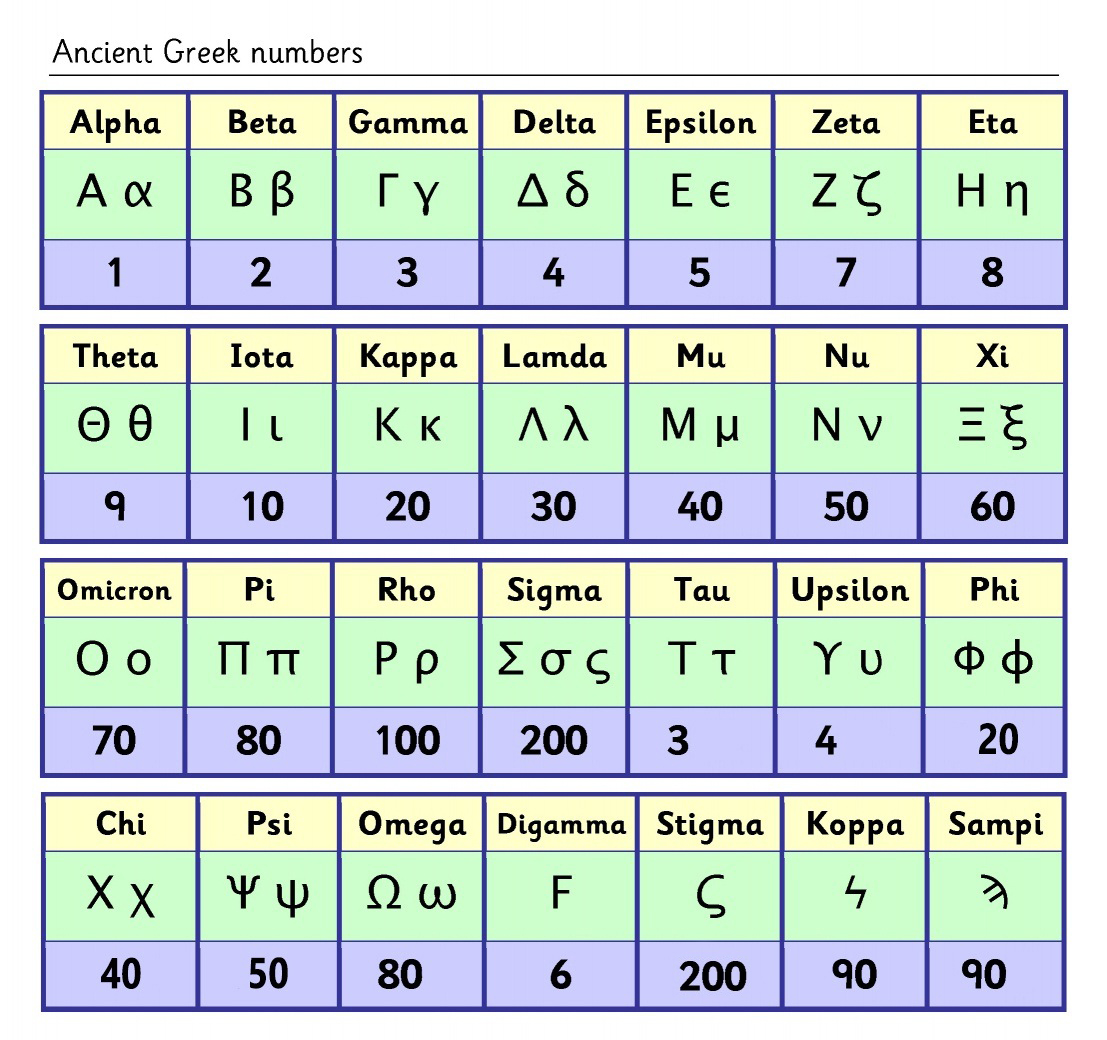
To arrive at these values, the Standard Isopsephy values are adjusted to match their Biblical Gematria counterparts, and so we use the extended version of Standard (which has the final forms of the letters extending into the hundreds) as a key. For example: because Standard Gematria (SG) has Shin as 300 but Biblical Gematria counts Shin with the value of 3, then Greek Tau is adjusted to 3 rather than 300; and because (SG) counts Peh sofit as 800, but in Biblical Gematria (BG) sofits have no different values to the normal letters so Greek Omega is counted as 80 rather than 800; and because Kaph sofit is 500 by (SG) but is 20 by (BG) then Phi, which has the Standard Isopsephy value of 500 is adjusted to hold the value of 20. Due to the fact that there is no natural relationship between the Greek letters Phi (20) and Kappa (20) as there is for Kaph and Kaph sofit which is the same letter with the only difference being the Kaph sofit appears at the end of a word, then it follows that Biblical Gematria was ported to the Greek script and not the other way on. Standard Isopsephy can be converted to Biblical Isopsephy by following how Biblical Gematria was changed to Standard Gematria, but Standard Gematria cannot be converted back to Biblical Gematria by simply comparing Standard Isopsephy with Biblical Isopsephy, and this conclusively proves the case that Biblical Isopsephy emerged from Biblical Gematria.
‘Jesus told them, “Bring some of the fish you have just caught.” So Simon Peter went aboard and dragged the net to the land, full of large fish, one hundred fifty-three. And although there were so many, the net was not torn.”
ιχθυων + μεγαλων + δικτυον + γην + 153 = 777.
of fish + large + net + land + 153 (the number of fish) = 777.
For our next verse, let’s have a look at the gematria of the name “Jesus Christ”. In Greek it is Ἰησοῦ Χριστοῦ which yields an Isopsephy value of 719, and this is significant because every twelve hours the hour hand and seconds hands of an analog clock align exactly 719 times, and perhaps the drips from a water clock would also coincide at this rate? Possibly someone who is an expert in ancient time pieces could answer that. In John 11:9 it says this:
Jesus answered, “Are there not twelve hours of day? If anyone walks in the day, he will not stumble, because he sees by the light of this world.”
Twelve hours = δωδεκα ωραι = 305
Of the day = της ημερα = 365
365 – 305 = 60anyone walks in the day = τις περιπατη εν τη ημερα = 720
720 / 60 = 12 (hours)not = possibly suggests the reverse symmetry that follows;
stumbles = προσκοπτει = 638
light + world + he sees = φως κοσμου βλεπει = 836 [reverse symmetry of 638 ‘stumbles’]anyone + light + world = τις φως κοσμου = 917 [reverse symmetry of 719 ‘Jesus Christ’]
For my third example, and since we’re only a week away from Christmas, I’m going to investigate the Isopsephy of the birth of Jesus, so we’ll pick up the Gospel of Matthew 2:1. Matthew helpfully follows the traditional conventions and signals where the gematria is by saying “behold!”
Τοῦ δὲ Ἰησοῦ γεννηθέντος ἐν Βηθλέεμ τῆς Ἰουδαίας ἐν ἡμέραις Ἡρῴδου τοῦ βασιλέως, ἰδοὺ μάγοι ἀπὸ ἀνατολῶν παρεγένοντο εἰς Ἱεροσόλυμα. λέγοντες Ποῦ ἐστιν ὁ τεχθεὶς βασιλεὺς τῶν Ἰουδαίων; εἴδομεν γὰρ αὐτοῦ τὸν ἀστέρα ἐν τῇ ἀνατολῇ καὶ ἤλθομεν προσκυνῆσαι αὐτῷ.
Word by word translation with gematria;
‘Then now [Jesus (292)], having been born in [Bethlehem (99)] the [of Judea (300)], in [the days (364)] [of Herod (266)] the [King (528)], behold, [Magi (124)] from the east arrived in [Jerusalem (530)], asking, “Where is [he who (70)] [has been born (272)] [King (452)] of the [Jews (229)]? We saw for [of him (82)] the [star (310)] in the east and [are come (212)] [to worship (743)] [him (88)].”The phrase “in the east” may be a biblical convention similar to “on the head” or “by the foot”; meaning that only the first syllable of the adjacent word should be considered. If that’s true then “in the east” would be the right hand side and “in the west” would be the left hand side of the word, altering the value of those words to the calculation. And they are:
Magi = MA[GOI (83)] = μάγοι
Star = Aste[ra (101)] = αστερα…which gives us;
530 Jerusalem + 83 Magi = 613
101 Star + 82 ‘of him’ = 183.… and although the greater value of the name (1012) is not here, the value of the name Jesus is interesting in connection to Hashem because; 1012 – 292 = 720; which is 365 x 2 [all the days + all the nights in a year].
613 is generally associated with the number of mitzvot in the Torah, but it is also discovered during the first few verses of Genesis as I explained in a prior blog here;
[Genesis 1:2-3] פְּנֵ֣י תְה֑וֹם – וְחֹ֖שֶׁךְ + אֽוֹר : the face of the deep – and darkness + light = 365
[Genesis 1:4] הָא֖וֹר + הַחֹֽשֶׁךְ : the light + the darkness = 248
365 + 248 = 613.183 is a value usually associated with a personification of Winter, or Winter King, who is usually the eldest brother of a King of Summer. We see the value pop up in Genesis 25:27 with; [Esau + Hunter (183)] + Jacob (182) = 365.There’s quite a lot more to this verse but that’s all I’ve got time for today. It’s a nice bit of gematria to find during the seasons holidays, but that wasn’t the main point of this post which has been to show QED that Greek Isopsephy in the New Testament is based on the Hebrew gematria of the Torah. I hope you’ve enjoyed this special installment. I’ll be back to Hebrew and Torah study in my next blog, so thank you for all your support and shares, and stayed tuned for more numerical honey.—————————————————-
Links
Shematria ~ Hebrew and Greek Biblical Gematria Calculator.[First published DEC 19, 2018, 1:59 AM; https://blogs.timesofisrael.com/how-biblical-gematria-entered-the-greek-script/].