BethSheba Ashe

Author & Researcher in the Original Gematria and the Precursor to the Tree of Life

You are here: Home / Archives for Kabbalah

Merkabah ~ the secret center of Kabbalah!

January 25, 2019 By BethSheba Ashe Leave a Comment

Welcome to my blog about biblical gematria, the merkabah and the birth of the alphabet.  In my next posts we’ll discover why the Merkabah is the beating heart of Kabbalah and its secret center.
Corrections
Before we start today, I’d like to address an issue that came up after my last blog post (besides the layout issues with the calculations).  I accidentally mislead by saying the Greek values had been transliterated.  In actual fact I’d reasoned that if biblical Isopsephy followed the pattern of biblical gematria then two of the letters of the standard Greek set would be incorrectly numbered as 300 and 400.  I determined that these were the Tau and Upsilon and I adjusted the values of those accordingly.  Likewise I adjusted the Greek letters that matched the sofit values of the Hebrew to their normally valued counterparts. So I started with the standard values for the Greek and adjusted them to biblical gematria with these tweaks.  My apologies; I’d temporarily forgotten how I came by them.  I should really take more notes…  Many thanks to David Allen Hulse for pointing out my error.

Kabbalah

The three most famous texts of Kabbalah are the Sefer Yetzirah, the Bahir and the Zohar and all of them are connected with either biblical gematria or with the conformations of the Seven Palaces [the Wheel of the Chariot].  The Yetzirah may have used biblical gematria with an ancient system of trigonometry, while the Bahir and the Zohar each contain midrash upon the Palaces.  One book of the Zohar in particular (the Sefer Dtzeniouthia) contains a riddling instruction for converting the diagram of the Tree of Life into the Seven Palaces.

The Sefer Yetzirah
The most famous and arguably the most controversial of the texts of Kabbalah is the Sefer Yetzirah.  There is debate over whether the text can even be classified as Kabbalistic due to the early date of its composition[1] and its gnostic influences.  I’ve studied it, but to tell you the truth I’ve never gotten very much sense out of it, which is a reflection on me and not the text.  Happily, my friend ‎ראובן הלוי has been doing rather better, and after analyzing the Sefer Yetzirah with biblical gematria (aka Chariot gematria) he believes that an ancient system of trigonometry may be embedded within the text.  He’s used biblical gematria with the 231 Gates of the Sefer Yetzirah.  I will quote him here in full:
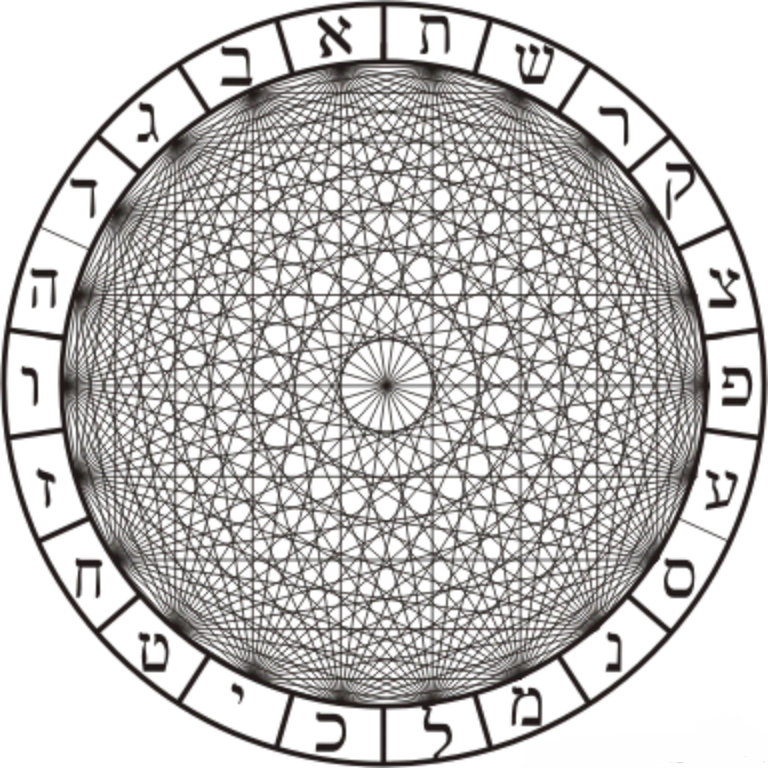
 

The 231 gates of the Sepher Yetzirah.

“I created a modified circle of letters by combining ג/ד into one section and ש/ת into one section since ש/ג and ד/ת share the values of 3 and 4 respectively. So instead of a circle divided into 22 sections, it’s now divided into 20 sections with the line between א and ב centered at the top, and the ג/ד and ש/ת sections directly opposing each other from either side of א and ב.

Following the logic of the Chariot, each gate is a line connecting two letters on the circumference of the wheel. The value of each gate is computed by adding the values of the two connected letters. So gate בא/אב would have a value of 3, gate מח/חמ would have a value of 48, etc. (A gate and its reverse are counted as the same gate, e.g. אב and בא are the same gate; חמ and מח are the same gate, etc.― Otherwise there would be 462 gates instead of 231.)

The major change that occurs using the Chariot gematria is that instead of every letter having a unique value (1 to 400) now there are two letters with the value of 3 (ג and ש) and two letters with the value of 4 (ד and ת). With two duplicated values it becomes possible to form triangles with their vertices located at the circumference of the circle.

Because ג and ש both have the value of 3, the gate from שת to ח and the gate from גד to ח can both have the same value of either 11 or 12. (If we use שת as 3, we have to use גד as 4. If we use שת as 4, we have to use גד as 3. Because either option is possible, gates שת―ח and גד―ח can be either 3+8=11 or 4+8=12.) We could also take שת and גד as both equaling 7. In that case, שת―ח and גד―ח would both equal 15. In either case, we can proceed around the circle as I’ve done in the rest of the images [ed – follow this link to see all 18 individual images].

Note that if ש is 300 and ת is 400, gates with equal values will only form parallel lines that never intersect. For example פי ,עכ ,סל and נמ all have the value of 90, but all of those lines are parallel, because in a circle, 80~10 contains 70~20, 60~30 and 50~40― so they will not intersect. If we take two random gates that do intersect, like במ and טק, the intersection will be somewhere in the middle of the circle, not at the circumference. Only the Chariot gematria allows triangles to be formed whose vertices are on the circumference of the circle.

There are 18 possible triangles that can be formed (see third image). If using 3 & 4 as the “counter-values” of שת―גד, the triangles two other gates values can be 4/5, 5/6, 8/9, 9/10, 10/11, 11/12, 12/13, 13/14, 23/24, 33/34, 43/44, 53/54, 63/64, 73/74, 83/84, 93/94, 103/104 and 203/204. If we use 7 as the counter-value of שת―גד, the triangles two other gates can have the values of 8, 9, 12, 13, 14, 15, 16, 17, 27, 37, 47, 57, 67, 77, 87, 97, 107 and 207.

What I have to do now (and I would much appreciate the help of someone more adept at mathematics than myself) is figure out if these values correspond to a table of sines/cosines. If so, then the Sefer Yezirah― when decoded with the Chariot gematria― contains an ancient system of trigonometry.” ~ ראובן הלוי

Unfortunately I can be of very little use to him as my mathematical skill is rather basic, so if you can help him take his research forward please get in touch!

Next up we’ll be taking a look at the the Sefer Bahir so stay tuned for more numerical honey.

—

[1]  Christopher P. Benton dated it to the time of the Mishna (2nd Century CE) due to its grammatical form, but Richard Reitzenstein placed its origin in the 2nd Century BCE.
ABOUT THE AUTHOR Bethsheba Ashe is almost Scottish. She was born a Geordie in the North East of England but she currently lives 3 thousand miles away in Pennsylvania. She started writing and self-publishing in 1992, with a series of magazines. She is the author of several non-fiction titles such as "Chariot", and has recently published her first adventure/murder mystery novel. She also coded and runs the gematria calculator app "Shematria". Bethsheba is an inventor and her invention is 'Galay'; which is the worlds first dual logographic and alphabetical writing script. Currently she is coding an app for Galay messaging. She's a quiet but intensely curious human being who likes to keep busy and she loves animals.
.

Filed Under: Gematria, Merkabah Wheel Tagged With: Gematria, Kabbalah, Sepher, trigonometry, Yetzirah, ראובן הלוי

Conformations of the Tree of Life

July 23, 2017 By BethSheba Ashe 1 Comment

“…Such an one is that man who ‎can neither institute the union of the Holy Name…” – The Book of Concealed Mystery.

The Tree of Life – showing Malkuth being added to Yesod – Portae Lucis, Augsberg 1516.

The Seven Palaces were hidden under the cipher of the Tree of Life and finding them required a student that was curious enough to ask themselves “I wonder what the original conformations of this diagram looked like?”

The first picture to be published of the Tree of life that wasn’t just a series of concentric circles, ‎was featured on the front cover of the Portae Lucis magazine in 1516[1].

Within a few centuries – new versions of the Etz haChayim (עץ החיים) [The Tree of Life] were popping up across Europe.  New paths were added to the Tree or the positions of the paths were altered.  Sometimes entire Sephiroth were added – no matter what the Sepher Yetzirah said[2]. Issac Luria and other later Kabbalists put much effort into this hermeneutical past-time, and they were joined by Western Occultists such as Frater Achad. These students redistributed the letters into something that was more pleasing and attuned to their personal view of the cosmos.

In it’s own private sphere this is a worthy inquiry if it assists the student to understand themselves somewhat better, but that isn’t the only motivation that people have when they start tweaking at the tree.  The Zohar contains an admonition in the ‘Book of Concealed Mystery’ that says “…derive the Supernals[3] into the position required…“ which is an open invitation to change the tree.

Notice that only one ‘position’ is mentioned. The word ‘position’ is not a plural, and Da’ath is not a Sephiroth, but ‘the position’.

The Seven Palaces – 5th knowledge lecture – The Complete Golden Dawn. Bill Heidrick noted the Golden Dawn diagram “This is the traditional depiction of the moment of the opening of the 50th Gate of Understanding, although there is little evidence that the matter was understood by the G.’. D.’. as such.”

When the supernals are combined in the position of Da’ath then the top half of the Seven Palaces are seen. When Malkuth is drawn back up into Yesod then all the Seven Palaces can be seen.

The Seven Palaces were hidden[4], and finding them required a student that was curious enough to ask themselves “I wonder what the original conformations of this diagram looked like?”  The first step in solving any really good puzzle or riddle is to take yourself out of the equation completely.  It’s not about what you think: it’s about what the writer means.  In a sense, it is a spiritual test… *to see* the Merkabah you have to first leave your ego at the door.

Students of the Golden Dawn had a slightly easier time of finding the original conformation of the Tree of Life because a picture of the Seven Palaces was given to initiates with their fifth knowledge lecture.  It’s a starting point but this diagram is devoid of any paths running between the palaces and it was mis-attributed as “the Seven Palaces of Assiah” (the lowest of the Kabbalistic four worlds).  Essentially the Golden Dawn lumped the Seven Palaces into the same category as the Qlippoth, without taking into account the ancient near east view of the cosmos with its Seven Heavens, Seven Earths and Seven Hells.

The idea of seven heavens originated in ancient Mesopotamia.  Sumerian incantations of the late second millennium BCE make references to seven heavens and seven earths. One incantation is: “an-imin-bi ki-imin-bi” (the heavens are seven, the earths are seven) and the Hebrew word for “heavens” was Shamayim (שָׁמַיִם 93).

What are the ten kings? They are the seven voices and three sayings (Amarim). – The Bahir.

To really comprehend the origin of the Tree of Life, you have to be a bit of a sleuth on an investigation – rather than an inventor at the potters wheel.  In a sense, you have to attack both the Torah and the Zohar as if they were cryptic crossword puzzles; analyzing every word to see if it has a second meaning.  Unlike a cryptic crossword the sources themselves require investigation and this can be especially difficult with translation.  Even the recent Pritzker edition has been ‘corrected’ with the Aramaic word for ‘Supernals’ having been replaced with another one for ‘Spheres’.

The Seven Palaces
The Seven Palaces

The phrasing of the full Zoharic admonition itself is a barrier to understanding;

“‎11. But what is to be understood by that ‎passage
“And they that despise Me shall be ‎lightly esteemed?”
Such an one is that man who ‎can neither institute the union of the Holy Name,
nor bind together the links of truth,
nor derive ‎the supernals into the position required,
nor ‎honour the Name of his Lord.
Better were it for ‎that man had he never been created,
and much ‎more for that man who doth not attentively ‎meditate when he saith Amen!”

– Chapter III – ‎Verse 11, ‘Kabbalah Unveiled’.

The line “and they that despise me shall be lightly esteemed” is lifted from Samuel 2:30 and it reads:

“Therefore the LORD God of Israel declares,
I did indeed say that your house and the house of your father should walk before Me forever;
but now the LORD declares,
‘Far be it from Me – for those who honor Me I will honor,
and those who despise Me will be lightly esteemed.

The theme of honour is repeated later in the verse; “…nor ‎honour the Name of his Lord…” but the word ‘honour’ in Samuel is מְכַבְּדַ֥י while the word used for ‘honour’ in the Zoharic verse is ‘הדר‘ which (according to Strong’s concordance) also carries the meanings of ‘to honor, adorn, and perhaps also ‘to swell’.   The word comprises three letters that appear on four of the seven palaces (the daleth appearing on two palaces).

In Deuteronomy the word ‘honour’ הדר is used in a very different context:  בכור שורו הדר ל֗וֹ  “As the firstborn of his bull honour to“, which makes a fascinating link with the bull god.  הדד ‘Hadad’ was the bull god son of the supreme Father of the Gods and creator deity אל El (31) and the three letters of the lowest Palaces form his name.  According to the Ba’al cycle texts found at Ras Sharma from Ugarit (6000 BCE – 1190 BCE)- Hadad lived in the Seven Palaces of his Father.

The next line of the riddle is “Such an one is that man who ‎can neither institute the union of the Holy Name.”  At the top of this page you’ll see a diagram that illustrates how – when the letters of the Seven Palaces are correctly attributed to the right Paths and Palaces; they coalesce to form values that are identical to the names of ancient biblical deities and major characters in the narrative. When placed in a logographic arrangement the numbers of the Seven Palaces recur and reflect around the structure.  For example:

Biblical Gematria

7 x 31 = 217.
2 + 3 + 5 + 7 + 200 = 217.
2 + 1 + 200 + 1 + 5 + 4 + 4 = 217.
197 + 20 = 217.
(5 + 3 + 4 + 90 + 100 + 4) + (2 + 8 + 1) = 217

200 + 40 + 8 = 248
217 + 31 = 248.

5 + 3 + 4 + 90 + 100 + 4 = 206.
217 – 11 = 206.

One cannot help but come away from a mathematical enquiry of the Seven Palaces, thinking that the interplay of the numbers upon each of the faces – with each depending on the others for support and existence – conveys a sublime insight into the interdependent functioning of the cosmos.

“…bind together the links of truth…“

What are the links of truth…?  One word for ‘link’ may be ‘qarse’ קַרְסֵ֥י with the value 370:
ועשית קרסי נחשת חמשים והבאת את־הקרסים בללאת וחברת את־האהל והיה אחד – Exodus 26:11.
“And you shall make 50 bronze clasps and put the clasps into the loops and couple together the tent that it may be one.”

Another word for ‘link’ might be עֲנָ֖ק Anaq (220) chain; a necklace, which shares its value with words such as ‘HaTorah’ and ‘Bereshith’, as well as with an arrangement of five of the six ‘inner paths’ that connect with the centered palace of the Resh.  These five paths never change their placement when the Tree is reformatted into the Seven Palaces.  They remain right where they are.  However the sixth path to connect with the Palace of Resh (from the Beth) is made of paths that were once connected to the three Supernals, and just as the Supernals went to make one Palace above, the connecting paths are bound together to make one interconnecting path comprised of the letters ג Gimel ה Heh and ז Zayin.

“50. We have learned (Proverbs 25:2), “The glory of God is to hide a word.”
What is “a word”? That of which it is written (Psalm 119:160), “The Beginning of Your
word is truth.”  [It is also written] (Proverbs 25:2), “It is the glory of kings is to research a word.”
What is this “word”? That of which it is written (Proverbs 25:11), “A word spoken in its
proper place (Aphen-av)”, do not read “its proper place” (Aphen-av), but “its wheel”
(Ophen’av)” – The Bahir.

Insight into how to arrange the letters from the lost paths of the Tree and onto the palaces are given in a Zoharic essay ‘The Mysteries of the Alphabet’.  In this narrative, God is deciding on what letter to begin the creation of the world with, and eventually he decides to begin with the letter Beth, yet he calls to the Aleph twice “Aleph!  Aleph!” and declares that his influence upon the earth shall only be expressed through the Aleph.  This is why the Beth is to the Seventh Palace (at the top) and the Alephs flank it on the palaces at either side.  The Bahir adds this insight into the location of the Daleths upon the Palaces:

“36. His students asked: Why is the letter Daleth thick on the side?
He replied: Because of the Segol which is in the small Patach.
It is thus written (Psalm 24:7), “The openings (pitchey) of the World.” There He placed a
Patach above and a Segol below. It is for this reason that it is thick.
37. What is the Patach? It is an opening (Petach).  What is meant by an opening? This is the direction of north, which is open to all the world. It is the gate from which good and evil emerge.” – The Bahir.

Daleth means ‘door’ – and the two doors on the Palaces are the Doors of Light and Darkness; Life and Death. Between the Palaces of the Doors is the Path of Peh, which begins the words ‘Petach’ and ‘Pitchey’.

A careful study of the Tanakh throws up a wealth of commentary on the conformations and qualities of the Seven Palaces.  Ezekiel is especially forthcoming about the conformations of the Seven Palaces.  For instance in Chapter 44:1-3:

1  Then He brought me back by the way of the outer gate of the sanctuary, which faces the east; and it was shut. 2  YHVH said to me, “This gate shall be shut; it shall not be opened, and no one shall enter by it, for the YHVH God of Israel has entered by it; therefore it shall be shut. 3  “As for the prince, he shall sit in it as prince to eat before YHVH; he shall enter by way of the porch of the gate and shall go out by the same way.”

[This means that no-one may may exit life via the same gate they were born (through the Palace of the Daleth in the East).  The ‘porch’ is the path of Peh – which was represented at the temple by a porch, and ‘the Prince’ is ‘Hadad’ (son of El) who lives in the Palaces of his Father according to the Ba’al cycle texts.]

Scattered among the early Kabbalistic texts, there are plenty of cryptic aids to assist in the discovery of the Seven Palaces. Unfortunately there have been few students who are even aware that they should have been looking for them.  Aleister Crowley was a different sort of man, and from his time with Scottish freemasonry he was quite clear that he should know about them.   From his accounts in ‘The Confessions of Aleister Crowley’ we can date the time of his discovery of the Seven Palaces to 1900.  His accounts make it explicitly clear that he was searching for the ‘Lost Word’ of the Freemasons; the word that was reputably only spoken by the High Priest within the presence of God in the tabernacle, and only once a year.

It’s fascinating that Crowley chose the verse he did to prove his assertions to knowledge of the Lost Word.  He gives an example from Genesis 17:5 – a verse that corroborates biblical gematria when shin = 3 and tav = 4 (as it does on the Seven Palaces).  ‘Abraham’ = 248 and המון גוים נתתיך “of many nations I will make” = 248.  By ‘standard’ gematria the sum total of המון גוים נתתיך is 1040.  It’s one of the rare examples in the Torah where the text directly verifies the gematria result.

“This exegetical method is not a modern invention.  When Jehovah selected a family to be the father of Israel, he changed the name (אברם (243 = Abram Father of Elevation into (אברהם (248 = Abraham Father of a multitude; and by way of compensation changed (שרי (510 = Sari Nobility to (שרה (505 = Sarah, Princess. There are several other similar stories in the Bible. A change of name is considered to indicate a change of nature.  Further, each name is not arbitrary; it is a definite description of the nature of the object to which it is attached. By a similar process, I am certain of my results in the matter of the Lost Word, for the Found Word fulfils the conditions of the situation; and furthermore, throws light on the obscure symbolism of the entire ritual.”

By 1904 he was using the gates of the Seven Palaces as a checksum for the riddle of Liber Al vel Legis and thereafter he keyed (or otherwise based) several of his best A.’.A.’. works to the Palaces – in effect creating a hidden system for the Inner Order of the A.’.A.’. and hiding the whole thing in plain sight.

It can be successfully argued that Aleister Crowley was just the latest of a long line of people who have attempted to create a systematic approach to initiation, but at least he had the virtue of of fully understanding the basis of the older system before he set out to create a new vehicle.


[1] The Tree of Life – showing the number ten being added to Yesod – by Paulus Ricius, Portae Lucis, Augsberg 1516.
[2] “Ten are the numbers, as are the Sephiroth, and twenty-two the letters, these are the Foundation of all things…[]…Ten are the numbers of the ineffable Sephiroth, ten and not nine, ten and not eleven. Learn this wisdom, and be wise in the understanding of it, investigate these numbers, and draw knowledge from them, fix the design in its purity, and pass from it to its Creator seated on his throne.” – 1:2-4, The Sepher Yetzirah.
[3] The Supernals are the top three Sephiroth of Kether, Chokmah and Binah.
[4] The Seven Palaces are at the core of Merkabah literature and Judah the patriarch forbade people to speak about Merkabah to one another.  Kabbalah came about largely in response to this prohibition upon free study; as a consequence the Seven Palaces was derived into the Tree of Life so that students could discuss the Merkabah in an enciphered fashion.

Filed Under: Gematria, Merkabah Wheel Tagged With: Aleister Crowley, Golden Dawn, Kabbalah, Merkabah, Portaelvcis, Seven Palaces, Tree of Life, Wheel

Copyright © 2025 · BethSheba Ashe · Log in