BethSheba Ashe

Author & Researcher in the Original Gematria and the Precursor to the Tree of Life

You are here: Home / Archives for BethSheba Ashe

The conventions of biblical gematria.

January 25, 2019 By BethSheba Ashe Leave a Comment

Yesterday I called the biblical art of gematria ‘sophisticated’, and today I’d like to elaborate a little upon that theme.

You’ll all be familiar with the concept of written grammar, but have you ever paid mind to numerical grammar?  It is by convention to numerical grammar that we structure our mathematical calculations the way that we do.  For instance, understanding the sum [ 220 / 7 = 31.428571r ] requires us to know which elements of the sum are arranged where and for what reason.  And before we do any calculation we also need to be familiar with the signs for math functions (like +, -, *, /, $, %, !) .  Therefore, because we require knowledge of the conventions, we need some degree of formal education in order to do math, and the same is true for biblical gematria.  There are numerical conventions for biblical gematria; it has a type of numerical grammar.

A student who is learning biblical gematria needs to develop an eye for the text they are working with.  They should try to see the cues, the math functions, the indicators, the logic of the calculation, the results, and finally ~ the sum in context with the other gematria calculations in the text.

Most indicators have a logical relationship ‎with their mathematical function, for instance:‎“et” = add, “not” = disregard, “on the head” = ‎the first syllable of a word, “bruise” = put two ‎words together, “the heel” = the end syllable of ‎a word.  So we’re going to be taking you on a bit of a whirlwind tour around the Torah, to alight on some of the common conventions of biblical gematria.  As promised, today we’re going to look at an unusual bit of gematria in the story of Ephraim and Manasseh; Genesis 48:14.

This calculation has something of the feel of a cryptic crossword clue about it.  When we read it we should be looking for logical relationships ‎between the words in the sentence:

וישלח ישראל את־ימינו וישת על־ראש אפרים והוא הצעיר ואת־שמאלו ‏על־ראש מנשה שכל את־ידיו כי מנשה הבכור

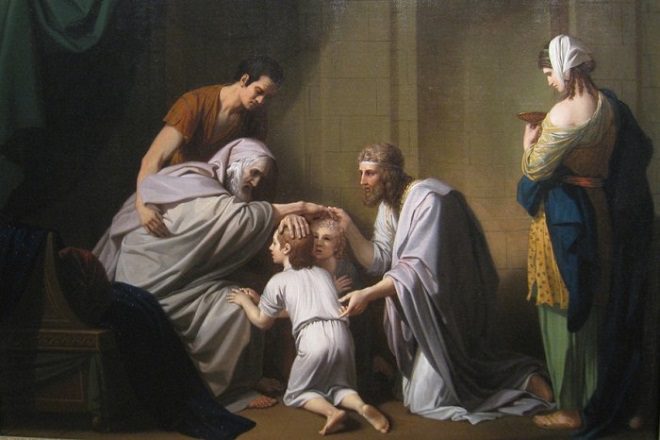
“But Israel stretched out his right hand and laid ‎it on the head of Ephraim, who was the younger, ‎and his left hand on Manasseh’s head, crossing ‎his hands, although Manasseh was the firstborn.”‎

The value of the names are exactly the same, until just ‘the head’ of the names are considered;

מְנַשֶּׁ֖ה הַבְּכֽוֹר ‘Manasseh the firstborn’ = 331
 אֶפְרַ֙יִם֙ ‘Ephraim’ = 331

Israel is touching both Ephraim and Manasseh which indicates the sum of the three names are to be added, but the text specifies that he is only touching them  עַל רֹ֤אש “on the head” which by convention means we should add ‎‎‘the head’ or first parts from each name, therefore we take the Peh and Aleph from Ephraim and the Mem from Manasseh:

יִשְׂרָאֵ֨ל‎ ‘Israel’ (244) + (‎‏(81) אֶפְ‎ of  ‎‏(אֶפְרַ֙יִם֙‎ + (‎‏ (40) מְof ‎מְנַשֶּׁ֑ה‎) = 365 (days).

And now we may ask ourselves “Why is the number of days in a year relevant to the story of Manasseh and Ephraim?”   Much of the gematria in Genesis concerns the Solar and Lunar cycles, and we see the number 365 appearing many times in Genesis as the text discusses the cycles of the solar year.  It’s first seen in Genesis 1:2-3;

365 = פְּנֵ֣י תְה֑וֹם – וְחֹ֖שֶׁךְ + אֽוֹר
“The Face of the Deep” – “and darkness” + “light” = 365

We see 365 again in Genesis 3:3;

ומפרי העץ אשר בתוך ־ הגן
“And the fruit of the tree which in the middle of the garden.

[In my experience of the calculating art, typically the use of the words such as בְּתוֹךְ ‘middle’ or ‘’between’ denotes the function of division by 2 of the following noun, which in this case is הגן ‘garden’ 58. Therefore: 58 / 2 = 29 and when we add this to ומפרי ‘and the fruit’ 336 results in 365 (days in a year).]

365 is central to the story of Jacob and Esau [Genesis 25:27];

עֵשָׂ֗ו + צַ֖יִד + יַעֲקֹב֙

Esau 79 + hunter 104 + Jacob 182 = 365

This story in particular has strong typological similarities to the 3rd millennium BCE Sumerian text The Debate between Winter and Summer.

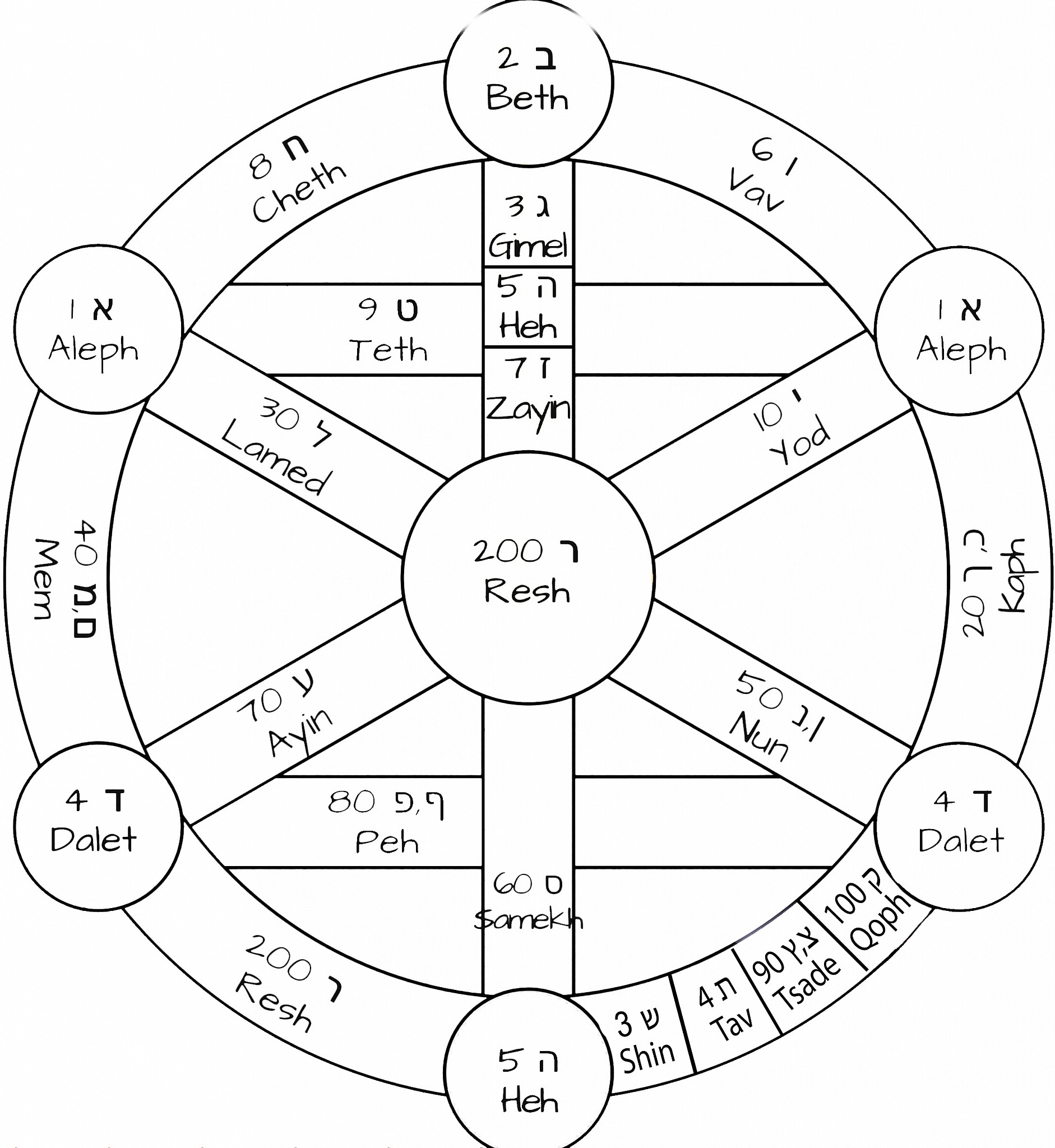
365 is a significant number to the Seven Palaces.  When the sum of the middle column is calculated (282 if we do not ‎use gates) and then removed from the total number (1012 ‎for the entire wheel) this leaves 730 and also splits the ‎wheel into two sections.

730 = 365 days + 365 nights.

When the letters Yod and Ayin are doubled on their paths we find the total sum from the Palace of the Aleph to the Palace of the Daleth is 365;

Aleph (1) + (Yod x 2 (20)) + Resh (200) + (Ayin x 2 (140) + Daleth (4) = 365.

And we also find the same calculation with the opposite diagonal;

Aleph (1) + (Lamed x 2 (60)) + Resh (200) + (Nun x 2 (100) + Daleth (4) = 365.
Lastly, the Talmud Yerushalmi Tractate Rosh Hashanah ‎‎2:5 says:

”The Holy One blessed be He ‎created 365 windows that the world might ‎use them:  182 in the east, and 182 in the ‎west and one in the center of the firmament ‎from which it came forth at the beginning of ‎the Creation.”‎

That’s it for today.  Continuing on tomorrow I’ll be discussing how the ancients thought about light, as well looking into the story of the expulsion of Adam and Eve from the Garden of Eden.  So stay tuned for more numerical honey.
ABOUT THE AUTHOR Bethsheba Ashe is almost Scottish. She was born a Geordie in the North East of England but she currently lives 3 thousand miles away in Pennsylvania. She started writing and self-publishing in 1992, with a series of magazines. She is the author of several non-fiction titles such as "Chariot", and has recently published her first adventure/murder mystery novel. She also coded and runs the gematria calculator app "Shematria". Bethsheba is an inventor and her invention is 'Galay'; which is the worlds first dual logographic and alphabetical writing script. Currently she is coding an app for Galay messaging. She's a quiet but intensely curious human being who likes to keep busy and she loves animals.

Filed Under: Gematria, Merkabah Wheel Tagged With: biblical, Eden, Ephraim, Garden of Eden, Gematria, Genesis, Jacob, Manasseh

The Lost Art of Gematria

January 25, 2019 By BethSheba Ashe Leave a Comment

Welcome to my blog.  With this blog I’ve elected to speak upon Biblical Gematria, the Merkabah, and the birth of the alephbet.  If you have any questions or comments, please feel free to express them in the comments section below.

“If I were asked to characterize the gematria of the Torah, I would call it a sophisticated, frequent, secret and very clever art form that is interwoven with the plain text.”

There is a great deal of gematria in the texts of the Tanakh. There is more than any one scholar could investigate in a lifetime of study.

The gematria of Genesis appears concerned with the planets and of those things spoken of in 1:14. The story of Adam and Eve is much clarified by the gematria; enabling us to see that the fruit of the Tree of Knowledge was light. The gematria of 1 Kings concerns the conformations of the Temple and how they are harmonized with the Seven Palaces. Ezekiel is also much concerned with the Temple and the Seven Palaces with his gematria, but he also has a bit of a dig at the ruler of Tyre… pulling his whiskers. Job… that’s a pure joy in terms of gematria; a real work of art both behind the scenes numerically as well as in plain composition.

Biblical gematria was a sophisticated practice that knew formal and informal conventions.  For instance, it is convention with some authors to signal the presence of gematria with a cue word like “Behold!”.  And since biblical gematria existed at a time before the Greeks or anyone else had thought to standardize mathematical notation, words stood in to do the job instead.  Touching something could signify addition (+), but eating from something is usually a sign of subtraction (-).  To magnify something is to multiply it by 10, but to get between two things expressed division by two.

Traditionally, biblical gematria has been something of a secret.  The same number set that appears on the Seven Palaces, is also the same one used in biblical gematria, and therefore it’s likely that the secrecy surrounding the Merkabah also wrapped around its gematria.

The Seven Palaces
The Seven Palaces

Secrecy is also the reason why gematria is something of a lost art.

On its own, the word (any word) stands in a void of isolation; bearing no relationship to other actors. It is simply a word and a number. Most of the time there is no intrinsic relationship between words that share a common number, other than what you would expect through randomness and chance.  Happily, since ancient gematria was focused on presenting and preserving mathematics and not on numerology this poses us no issues at all.

All the number values for Biblical Gematria are the same as Standard Gematria except that the letter shin is counted as 3 (not 300), and the letter tav is counted as 4 (not 400).  The finals are counted with their small values (i.e. ץ  = 90, not 900).  I’ve encoded a gematria calculator for convenience which is available at shematria.com, but if you’re using a pen and paper, then the number values for biblical gematria are these;

א 1 ב 2 ג 3 ש 3 ד 4 ת 4 ה 5 ו 6 ז 7 ח 8 ט 9 י 10 כ 20
ל 30 מ 40 נ 50 ס 60 ע 70 פ 80 צ 90 ק 100 ר 200

To really understand how clever the art of biblical gematria is, we need to view a few examples firsthand.  So let’s start at the very beginning with Genesis 1:1;

בראשית ברא אלהים את השמים ואת הארץ

“In the beginning (220) created (203) Elohim (86) ath (+) The Heavens (98) vath (and +) The Earth (296).”

et and v’et are excluded from this calculation because et almost always signifies addition.  The word bra is a verb and not of consequence to the calculations except to signify addition.

220 + 86 + 98 + 296 = 700.
יָמִ֖ים is the word for ‘days’ (100).

700 = 100 x 7 = The Seven Days of Creation.  But perhaps the 700 is also representative of the Seven Palaces themselves?  These palaces were considered to be the abode of God; each part under the governance of a letter of the alphabet, and each letter representing a quality of the heavenly and earthly life.

More instances of 700 that appear in the Tanakh are;

  • Abraham (248) + Isaac (208) + Israel (244) = 700.
  • Exodus 25:10-11 is as follows:אֲר֖וֹן = Ark = from ‘אָרָה’ meaning ‘to pick’ [fruit] or ‘to gather’ [myrrh].
    עֲצֵ֣י = wood 170
    שִׁטִּ֑ים = acacia 62
    זָהָ֣ב = Gold 14
    טָה֔וֹר = Pure 220.
  • According to the text, the ‘pure gold’ is overlaid both inside and outside the Ark, therefore we use the sum for ‘pure gold’ twice:  Wood 170 + Acacia 62 + (Pure 220 x 2) + (Gold 14 x 2) = 700.  Perhaps you know of more instances of 700?  Why not drop me a line and let me know.  If you’d like some homework, why not find out why 217 was a significant number to the ancients?

—

Thank you for reading my first blog post with the Times of Israel.  In my next blog post I’m going to be looking at a text that that does something very usual with the gematria when someone crosses his arms, so stay tuned for numerical honey.

ABOUT THE AUTHOR Bethsheba Ashe is almost Scottish. She was born a Geordie in the North East of England but she currently lives 3 thousand miles away in Pennsylvania. She started writing and self-publishing in 1992, with a series of magazines. She is the author of several non-fiction titles such as "Chariot", and has recently published her first adventure/murder mystery novel. She also coded and runs the gematria calculator app "Shematria". Bethsheba is an inventor and her invention is 'Galay'; which is the worlds first dual logographic and alphabetical writing script. Currently she is coding an app for Galay messaging. She's a quiet but intensely curious human being who likes to keep busy and she loves animals.
.

Filed Under: Gematria, Merkabah Wheel Tagged With: Gematria, Seven Palaces

The Gematria of Man

November 19, 2018 By BethSheba Ashe Leave a Comment

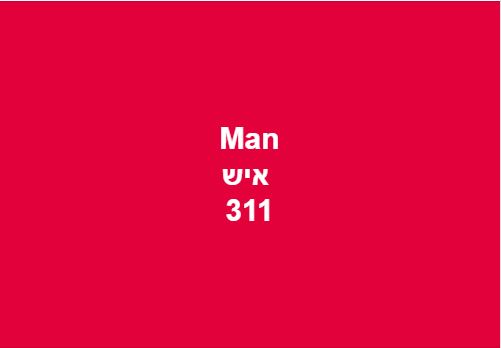
One of the consequences of studying the gematria of the bible is that I look at this and instantly count the proper value of 14 for the hebrew word for ‘man’.  AISh ~ Aleph = 1, Yod = 10 and Shin = 3.

One of the other consequences of studying the gematria of the bible is that the number of a word is of very little consequence to me, unless it is used in a deliberate biblical calculation somewhere in the Torah, or in subsequent Jewish writings.

On its own, the word (any word) stands in a void of isolation; bearing no relationship to other actors. It is simply a word and a number. Most of the time there is no intrinsic relationship between words that share a common number. When chance coincidences occur, the whimsy of these things can delight me when I see the role that chance and randomness play in our imaginations. But I don’t take it as a serious method of biblical analysis.  It’s not “the Sod”.  For instance this;

יאש  Meaning: to desist, i. e. (figuratively) to despond. Usage: (cause to) despair, one that is desperate, be no hope.

…this word ‘IASh’ also has a gematria value of 14, but are we to take the rather gloomy prophecy from this that man is a hopeless case because the number of the word man shares its digits with that of IASh? Come on… it really is utter nonsense, isn’t it?  At best it’s a form of imaginative numerical doodling that can randomly stimulate creative ideas.  You can do the same thing watching clouds though.

So if you want to study the hebrew language, why not take a look at their words in context?  The first incidence of AiSh in the Torah, that is without other prefix and suffix letters, occurs in Genesis 2:24:

על כן יעזב איש את אביו ואת אמו ודבק באשתו והיו לבשר אחד׃

It says “There-after will leave a man (+) his father and (+) his mother and join in his wife, and become to flesh one.”

Go and study the interlinear text for a while and come back to this.

https://biblehub.com/text/genesis/2-24.htm

All done?  Right.

If we consider the logic of the relationships of the actors to one another; clearly the sum of the man must be subtracted from the sum of his mother and his father, but his sum is joined to that of his wife.

My working hypothesis is that the text is disclosing the calculation of an intercalary 13th month.  To keep a 12-month lunar year in pace with the solar year, an intercalary 13th month would have to be added on seven occasions during the nineteen-year period (235 = 19 × 12 + 7).  When Meton introduced the cycle around 432 BC, it was already known by Babylonian astronomers.

Gematria Numbers:

AiSh : Man = 14

BaShThv : In his wife = 16

AiSh BaShThv : Man in his wife = 30

Abiv : His Father = 19 (years)

Amv : His Mother = 47 (47 x 5 = 235)

LbShr : to flesh = 235 (a period of 19 years is almost exactly equal to 235 synodic months and, rounded to full days, counts 6,940 days. The difference between the two periods (of 19 years and 235 synodic months) is only a few hours, depending on the definition of the year.  19 × 12 + 7 = 235. )

Achd : One = 13 (an intercalary 13th month)

LbShr Achd : One Flesh = 248 (8 x 31).


The Calculations:

Abiv – AiSh = 3 : His Father – Man = 3

Amv – AiSh = 33 : His Mother – Man = 33

3 + 33 + BaShThv 16 = 52 (weeks in a year)

3 + 33 + BaShThv 16 + Aish 14 = 66

One Flesh 248 – His mother 47 – His Father 19 = 182 (half a year/ winter/summer).

In verse 25 it says the man and his wife were naked עֲרוּמִּ֔ים (366) and not ashamed (18).  There are 366 days in an intercalary year.  366 is the sum of the ‘man’ and ‘in his wife’ in 2:24, when added to the remaining from the man being subtracted separately for his mother and his father + the letters Resh (200) and Qoph (100).  However, the bible uses the word HaAdam instead of AiSh ‘man’ in verse 25, which gives  וְאִשְׁתּ֑וֹ + הָֽאָדָ֖ם = 70 : The Adam and his woman = 70.

In the tarot, the letter Resh is attributed to ‘The Sun’ and the Qoph is attributed to ‘The Moon’.  The letters of Qoph and Resh are also attributed to these particular verses (2:24-25) of Genesis:

http://bethshebaashe.com/genesis-chapters-1-2-tarot

If Adam and Eve were personifications of the Sun and Moon, it would go a long way to explain the genealogy of Jacob and Esau (who personify the Summer and the Winter) later on in the Book of Genesis.  Were it not for tradition that insists upon treating these biblical characters first and foremost as human beings, the idea that seasons are descended from an impressive lineage like the Sun and the Moon, is far easier to swallow than the idea that the seasons came from human beings.


In case you haven’t heard yet; you can now use the Shematria biblical calculator to help you explore the bible with gematria!  Shematria is coded using the original paleo-hebrew sourced gematria that the bible was originally written in.  So make sure that you bookmark that for future reference.

Please consider donating to the app, so that I can continue to update it with features like a Greek database, or opening up a users only area.  Thank you.

Filed Under: Gematria Tagged With: 2:24, adam, AiSh, biblical, cycle, Gematria, Genesis, man, Metonic

Liber Al vel Legis 1:3-4

June 13, 2018 By BethSheba Ashe Leave a Comment

“… a cipher involving higher mathematics, and a knowledge of the Hebrew, Greek and Arabic Qabalahs as well as the True Lost Word of the Freemason, is yet veiled within the casual silk-stuff of ordinary English words…” – Aleister Crowley.

Now that the Shematria app is working and has the Book of the Law available to browse through and calculate verse by verse, it’s much easier to analyse the various puzzles in the book.  Check out this latest find!  It’s all calculated with the gematria of the Merkabah (of course).  Find out more here or read Aleister Crowley’s Secret Temple ($7.77) for more information…

Simply type “Book of the Law” or “Liber Al vel Legis” and the chapter and verse you’d like to study.  Or if you’d like to study the bible to compare just enter the name of the book + chapter + verse.  There are some very neat parallels between Liber Al vel Legis and Genesis.  See how many you can spot!

Filed Under: Aleister Crowley, Gematria Tagged With: Aleister Crowley, book of the law, every man and every woman is a star, Gematria, Liber al vel legis, pi

Aleister Crowley’s Secret Temple – Second Edition

April 4, 2018 By BethSheba Ashe Leave a Comment

http://bethshebaashe.com/wp-content/uploads/2018/04/ACST-SE-Banner.mp4
Buy the Paperback version of Aleister Crowley’s Secret Temple…

Reviews for Aleister Crowley’s Secret Temple…

“This book is excellent! A must have for any library. The author certainly knows her subject. I’ve been studying Merkabah since the early 90’s. She is an expert in this field. They long encoded mysteries have been brought forth! This is artistic genius!” ~ By PLaGuardia.


“The ‘Book of The Law’ is probably Crowley’s greatest literary achievement, if not one of the most significant texts of esoteric lore. To fully understand and appreciate its multi-faceted content Alrah Fraser delves deep into the ‘mystery behind the mystery’, a concept that is at the heart of much arcane knowledge. The ‘Merkabah’ is the key to Crowley’s system, and although this must be thoroughly delineated, it is to the author’s credit that she does not falter whilst gathering together the many threads of the mystery. The result is a clear and concise exposition of this particular fount of learning, one fundamental to any worthwhile understanding of the Kabbalah.” ~ By Caduceus.


“This is not your “run of the mill” take on The Book of the Law using gematria. This is book that looks at the Book of the Law through the eyes of a professional cryptographer! Aleister Crowley’s Liber vel Legis was “unlocked” by Frater Jones using his key of 31. But for a lot of Thelemites (and non-Thelemites) there seemed to be more to this book. Well Soror Alrah Fraser has unlocked even more of Liber vel Legis, and shows how it fits into the Merkuba system of attainment. I highly recommend this book!” ~ By Mysticqabalah.


“For those of us who love Tarot, Numerology, Gematria, Qabalistic studies, Crowley, the mysteries of the universe and more, this carefully illustrated and explained study of the Tree of Life is an informative and enjoyable read.” – By Marie Clewley.


“Everyone who studies magick wants to more deeply understand the universe, and this book greatly assists in meditation and reflection of Liber AL as well as other texts. The addition of the Merkabah as a map of understanding is especially useful for those who have seen the perfection of the universe, to which the Tree in its classical sense is no longer completely valid.” ~ By lasphodelius.


“In the greatest symbolism of all, however, the symbolism beyond all planetary and Zodiacal considerations, this card is the feminine complement of the Fool, for the letters Aleph Lamed constitute the secret key of the Book of the Law, and this is the basis of a complete Qabalistic system of greater depth and sublimity than any other. The details of this system have not yet been revealed. It has been thought right, nevertheless, to hint at its existence by equating the designs of these two cards.” – Aleister Crowley, The Book of Thoth, Adjustment.

Read it with Ipad, Kindle
or Paperback

Available Today
Available Today

#Aleister Crowley #Thelema #Book of the Law #Seven Palaces #Merkabah #Gematria #Qabalah

Filed Under: Aleister Crowley, Gematria, Merkabah Wheel, Tarot Tagged With: A.'.A.'., ACST, Aleister Crowley, Gematria, Merkabah, Secret Temple, Thelema

Merkabah Quiz

March 9, 2018 By BethSheba Ashe Leave a Comment

Test your knowledge of the Merkabah! 

Are you a Merkabah Master or do you still need training wheels?


Play our Quiz!


Merkabah Gematria Key:  א 1 ב 2 ג 3 ש 3 ד 4 ת 4 ה 5 ו 6 ז 7 ח 8 ט 9 י 10 כ 20 ל 30 מ 40 נ 50 ס 60 ע 70 פ 80 צ 90 ק 100 ר 200

Filed Under: Gematria Tagged With: Merkabah, Quiz

  • « Previous Page
  • 1
  • 2
  • 3
  • 4
  • 5
  • 6
  • 7
  • Next Page »

Copyright © 2025 · BethSheba Ashe · Log in