BethSheba Ashe

Author & Researcher in the Original Gematria and the Precursor to the Tree of Life

You are here: Home / Archives for Genesis

Seven Hundred and Seventy Seven ~ 777

January 25, 2019 By BethSheba Ashe Leave a Comment

Seven Hundred and Seventy Seven

Welcome to my blog on gematria, the merkabah and the birth of the alphabet. I hope you enjoyed the holiday season.  Although I promised I’d be back in the new year with an article about the Sefer Bahir and the Seven Palaces, that is taking rather longer to write than I had anticipated so I’ll bring that back at some time later this year.  Today I’d just like to share some of my recent findings about the gematria of the seven palaces which are proving to be quite a lot of fun.
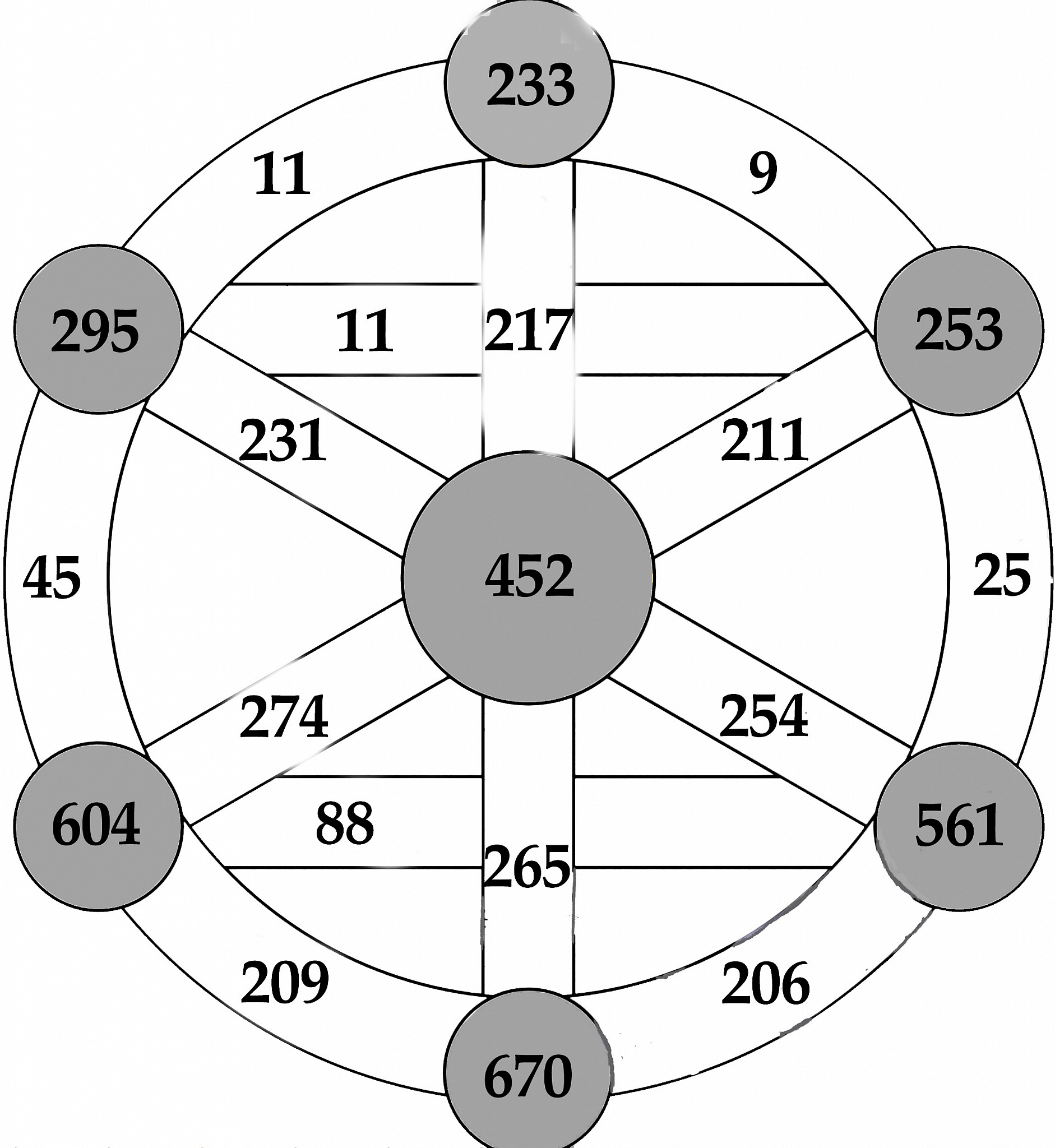
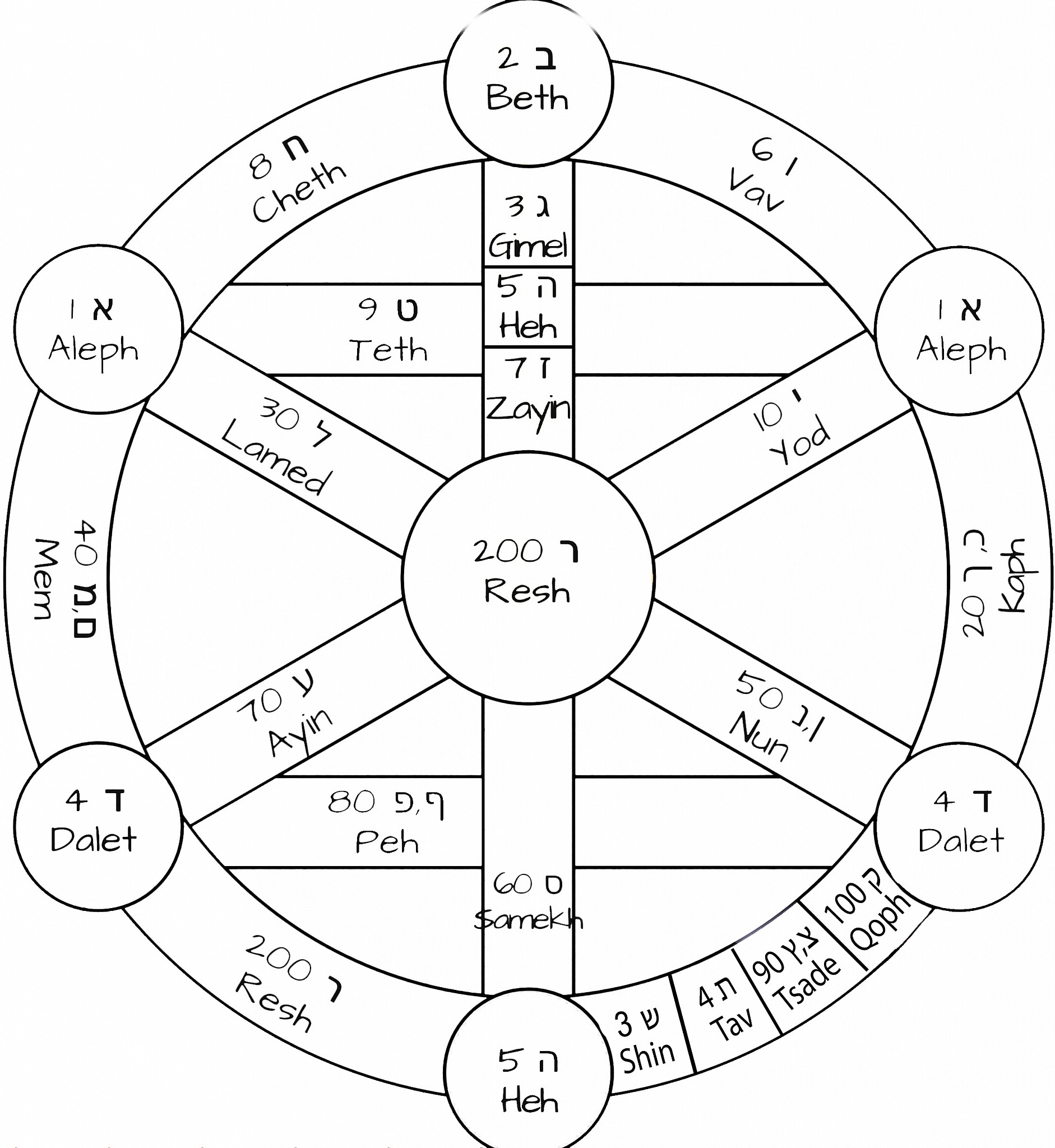
The main Gates of the Seven Palaces

Add together ALL of the main gates of the wheel for all the letters of the paths (not the palaces) to find the sum is 3108 which is 777 * 4:

[217 x 3] + [206 x 4] + 9 + 11 + 11 + 25 + 45 + 88 + 209 + 211 + 231 + 254 + 265 + 274 = 3108 = 777 x 4.
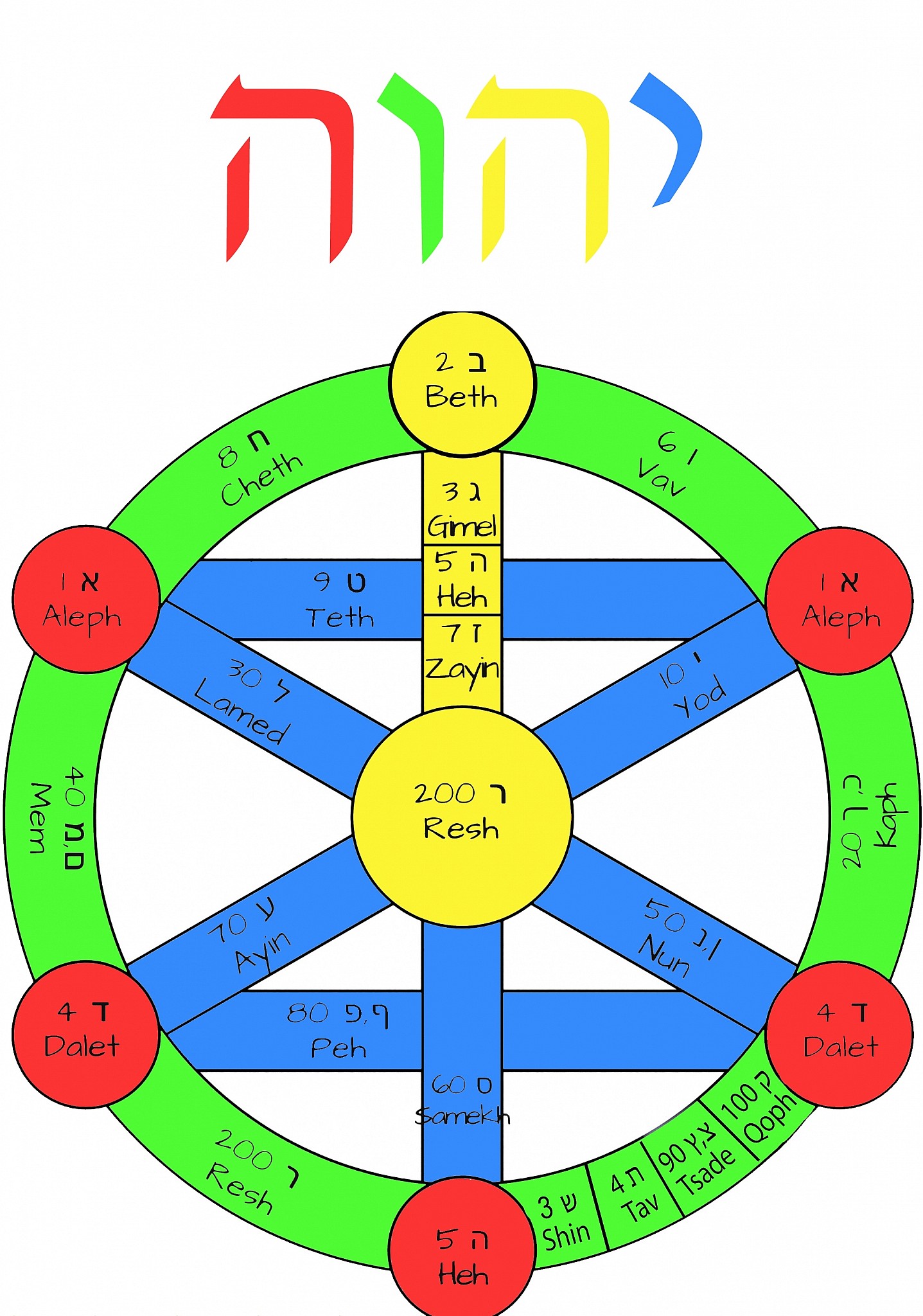
In respect of the gates, I thought these examples were pleasing compositions:

Gate of Shin = 12
Gate of Tav = 13
Gate of Tsade = 99
Gate of Qoph = 109
12 + 13 + 99 + 109 = 233 (the gate of the Seventh Palace).

670 – 452 = 218
218 + 265 + 217 = 700.


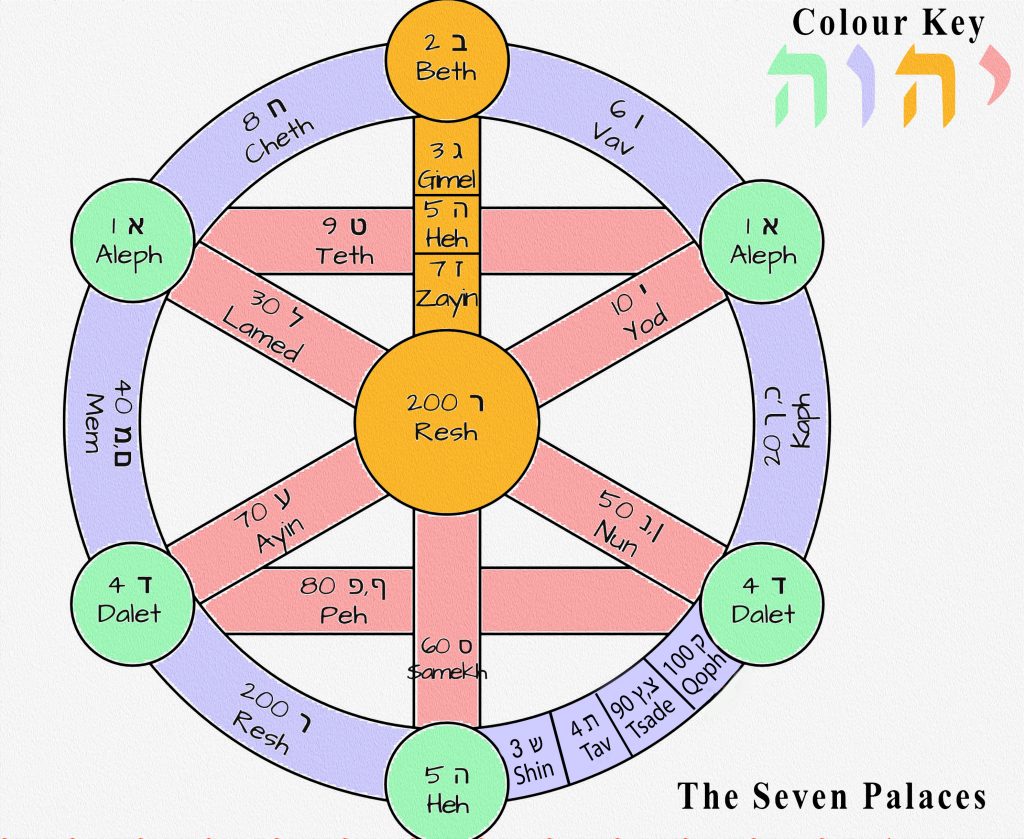
The Seven Palaces colour coded to HaShem.

When the Seven Palaces is organized into three columns it also totals to 777;
From Beth around to Heh on the left side; 2 + 8 + 1 + 40 + 4 + 200 + 5 = 260
From Beth to Heh down the middle; 2 + 3 + 5 + 7 + 200 + 60 + 5 = 282
From Beth around to Heh on the right side; 2 + 6 + 1 + 20 + 4 + 4 + 3 + 90 + 100 + 5 = 235
260 + 282 + 235 = 777.


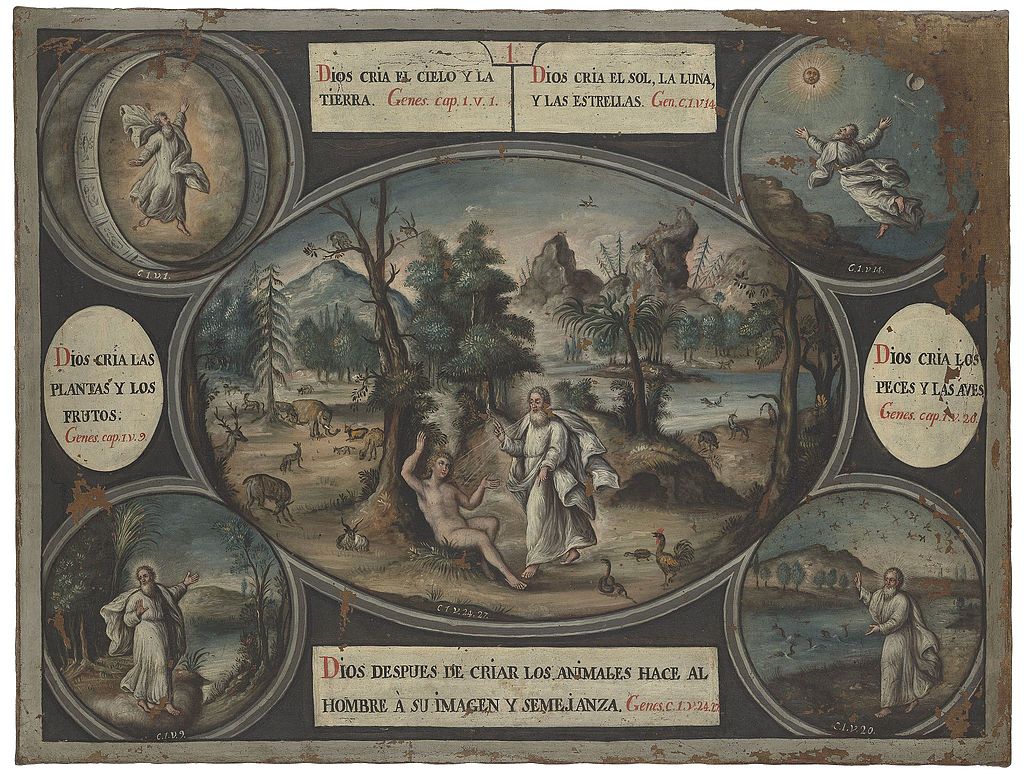
I’ve also been doing a little bit of work with the organization of the bible at the moment.  According to the Masoretic text, there were 10 generations from Adam to Noah, inclusive. There were another 10 generations after Noah and to Abraham, inclusive.  This may not be a coincidence, but a sign of organization.  Perhaps, like the opening 2 chapters of Genesis, the rest of the text has been organized into an alphabetic acrostic of ancestors, but arranged to the 20 count? I’ve made some notes about the gematria of the names and although not all of them yielded to my examination, a few of them threw up some intriguing results. Speculatively then, using the same order as we find the first Genesis alphabetic acrostic;

Order.  Generation, (# of name), letter of the alphabet, mnemonic, [my notes];

  1. HaAdam, (50), Beth, The House of God [Note 50 + 2 Beth = 52 (weeks of the year).]
  2. Seth, (7), Aleph, Day and Night [Note ~ 7 for the days of the week.]
  3. Enos, (60), Gimel and Shin, The Sky and Fire – Heat – Warmth – Dry Land [Note ~ 60 x 3 gimel = 180.  60 x 3 shin = 180.  180 + 180 = 360 (degrees in a circle)…]
  4. Cainan, (210), Daleth and Tav, The Doors into and out of the World, and Time [Note ~ 7 x 30. Also, 210 – 4 = 206; the gate of the first path which is where the tav is located (דשתצקה).]
  5. Mahlaleel, (136), Heh, Stars and Starlight upon the World.
  6. Jared, (214), Vav, Birds and Fish [Note ~ 214 + 6 = 220.]
  7. Enoch, (84), Zayin, Cattle and Insects [Note ~ 84 / 7 = 12. 84 x 7 = 588.  588 / 12 = 49 = 7 x 7.]
  8. Methuselah, (91), Cheth, Sight – Vision – The Image of God [Note ~ 91 x 8 = 728 (364 x 2).]
  9. Lamech, (90), Teth, Food [Note ~ Teth is 9 so ‘Lamech’ is 10 x 9.]
  10. Noah, (58), Yod, Rest and Contemplation
  11. Shem, (43), Kaph, Mist – Rain and Desire [Note ~ 43 is half of אלהים ‘Elohim’ ]
  12. Arphaxad, (308), Lamed, Spirit – Neshamah [Note ~ 248 + 60 = 308.]
  13. Salah, (41), Mem, Pregnancy [Note ~ אם ‘Am’ means ‘mother’ with a value of 41.]
  14. Eber, (272), Nun, Life and Death
  15. Peleg, (113), Samekh, The Great River
  16. Reu, (276), Ayin, Temptation
  17. Serug, (212), Peh, Mating and sex [Note ~ 212 + 80 = 292 / 80 = 3.65, but also 212 / 80 = 2.65. Remove the decimal point in these results for 365 days in a year and 265; the gate of the samekh.]
  18. Nahor, (264), Tsade, Childbirth [Note ~ 264 days is the length of an average pregnancy.]
  19. Terah, (212), Qoph, The Moon – Woman – Eve [Note ~ the name of the Moon-god in North Syria was “Terah.”.]
  20. Abram / Abraham, (243 / 248), Resh, The Sun – Man – Adam.

It begs the questions; if this alphabetic acrostic forms the basis of the generations of Adam, then does it follow suit for the descendants of Abraham too?  And if so, does this mean the Seven Palaces was used by biblical authors as a sort of… ancient sacred Filofax?  What do you think?

777 days a week

Welcome to my blog about gematria, the merkabah and the birth of the alephbet.  This is a short addendum to yesterdays post.

ראשון שני שלישי רביעי חמישי שישי שבת = 777

Gematria #    Hebrew     English  Transliteration 
 ראשון                  260  Sunday  Rishon
 שני                      63  Monday  Sheni
 שלישי                    56  Tuesday  Shlishi
 רביעי                  292  Wednesday  Revi’i
 חמישי                   71  Thursday  Chamishi
 שישי                    26  Friday  Shishi
 שבת                      9  Saturday  Shabbat

= 777

What are the odds that the days of the week would sum to 777?  Pretty incredible, isn’t it?  You can use my gematria calculator to check it out if you’d like;  Shematria.

Which is more likely… that the days of the week sum to seven hundred and seventy seven by coincidence?  Or that the seven words have been carefully pruned or developed to fit an ideal ‘perfect’ number to the glory of God?  And whom might have arranged for such a thing?  This poses a lot more questions than answers at the moment.  Let me know what you think.

Stay tuned for more numerical honey…

[Reposted here from my blog with The Times of Israel; 777; episodes 12 & 13].
ABOUT THE AUTHOR Bethsheba Ashe is almost Scottish. She was born a Geordie in the North East of England but she currently lives 3 thousand miles away in Pennsylvania. She started writing and self-publishing in 1992, with a series of magazines. She is the author of several non-fiction titles such as "Chariot", and has recently published her first adventure/murder mystery novel. She also coded and runs the gematria calculator app "Shematria". Bethsheba is an inventor and her invention is 'Galay'; which is the worlds first dual logographic and alphabetical writing script. Currently she is coding an app for Galay messaging. She's a quiet but intensely curious human being who likes to keep busy and she loves animals.

Filed Under: Gematria, Merkabah Wheel Tagged With: 777, Days of the Week, Gematria, Genesis

More about the Genesis alphabetic acrostic

January 25, 2019 By BethSheba Ashe Leave a Comment

Episodes in the Book of Genesis

Welcome to the fourth installment of my blog about gematria, the Merkabah and the birth of the alephbet, and a happy Hanukkah to you all.

Yesterday I gave you the Genesis alphabetic acrostic to contemplate, but today I’m going to attempt a brief potted commentary on it, although its really something I feel should be expounded upon by a more learned soul than myself.  I’m not going to throw open all the gematria of the first two chapters of Genesis for you, because that would deprive you from the fun of finding out new things about the Torah for yourself, but I will point out the most interesting or pertinent information as I can.

What the presence of the acrostic means is that we have far more information about the qualities of the letters and their attributions to the Seven Palaces.  It functions as verification of the great antiquity of Genesis, given that the Shin and Tav are placed in their earliest order and not at the back of the alephbet.  The acrostic also means that we have a lot more information about these two chapters of Genesis herself.  For example, when on the path of Cheth, said Elohim :

Let Us make man in Our image, according to Our likeness; and let them rule over ‎the fish of the sea and over the birds of the sky and over the cattle and over all the earth, and over ‎every creeping thing that creeps on the earth.

~ we already know that the fish of the sea and the birds of the sky were created with the Vav, and that the cattle and creeping things were created with the Zayin; so with the Cheth ruling at the head we have the word חזו meaning vision or appearance.

The verses of Genesis, and indeed all the Torah were first publicly numbered (as we find them today) by Robert Estienne (Robert Stephanus) in 1571, but the ‎move was not without criticism at the time from traditionalists.  The manuscripts that he worked from did not ‎contain the chapter and verse divisions in a numbered form.

The progression through the alephbet in Genesis starts with a Beth (2) for the Seventh Palace (at the top) rather than an Aleph, though Aleph (1) is the smaller number.  There are also two Alephs for the two Palaces directly to the left and right of the Beth, as if Beth had been split into two, like a new shoot, to form the Palaces of the Alephs; of Day and of Night.  Beth is also the letter that begins the Book of Genesis with the word בראשית, which has the value of 220 [and 220/7 gives a pi approximation].

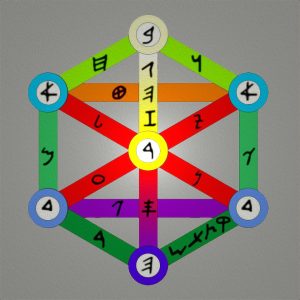
The Seven Palaces with Gate correspondences.

Kabbalah supports the idea that the Beth begins the acrostic with the Aleph coming afterwards.  Note the the Aleph is called twice:

The Creator told her, “Aleph, Aleph, although the world was created with the letter Bet, you will be the head of all the letters, for there is no unification in Me, except in you. In you will all calculations begin, all the works of the people of the world, and the whole unification is only in the letter Aleph.” ~ Sepher Ha Zohar.

The letter Beth means “house” or palace and it was where Elohim was thought to dwell in the thick darkness of the watery expanse that the ancients believed surrounded the earth.  It is from this Seventh Palace that he began his work to create the Heavens (or the Sky) and the Earth with his sacred signs.

If you’re exploring the gematria of Genesis it’s worth noting that gematria calculations are generally intended to come to fruition over several subsequent verses, so if you can’t determine what text is telling you in that verse, see if the values are carried over to the next verse.  For instance:

[Genesis 1:2-3] פְּנֵ֣י תְה֑וֹם – וְחֹ֖שֶׁךְ + אֽוֹר  : the face of the deep – and darkness + light = 365
[Genesis 1:4]  הָא֖וֹר + הַחֹֽשֶׁךְ  : the light + the darkness = 248
365 + 248 = 613.

The Talmud tells us that there are 613 commandments in the Torah; 248 Positive Commandments (do’s) and 365 Negative Commandments (do not’s), however there is disagreement on whether 613 is the right number since the matter rests on gematria that would, if calculated with biblical gematria rather than Standard, result in the value 217, but on the other hand it may simply be that the use of Standard Gematria rather than Biblical Gematria is the norm in the Talmud.  I cannot explain what 613 has to do with the Palaces of the Aleph or the Day and Night, so answers on a postcard please…

If I were to mnemonic the letters via the descriptions from Genesis they’d probably resemble something like this:

Beth ~ Gods house, everything in Heaven and Earth.
Aleph ~ Light/ Day and Night.
Gimel ~ Sky / Heaven.
Shin ~ Fire / Dryness / Heat.
Daleth ~ Doors into and out of the world.
Tav ~ the Measurement of Solar and Lunar Time.
Heh ~ Stars and Starlight.
Vav ~ Birds, Fish and Sea Monsters.
Zayin ~ Cattle and Insects.
Cheth ~ Sight, Vision, Appearance, Prophesy, Man.
Teth ~ Food.
Yod ~ Rest and Contemplation.
Kaph ~ Mist, Rain, Desire.
Lamed ~ The breath of Life, Ruach.
Mem ~ Pregnancy.
Nun ~ Life, but also Death for all living things under the Sun.
Samekh ~ the great River.
Ayin ~ Temptation.
Peh ~ Mating.
Tsade ~ Childbirth, because Eve is regarded as the first birth according to Kabbalah.
Qoph ~ Moon / Eve / female.
Resh ~ Sun / Adam / male.

The letter Daleth needs a little further explanation; as it is assigned to two Palaces, but only one of them – the one to the left – is being discussed in her verses.  This Palace represents the door through which all things enter into the world from heaven.  It’s twin on the right side is the door through which all things exit the world and enter heaven.  In these verses, though they seem to be about the creation of trees and vegetation in the world, the take away is that it is the first time God has caused anything to live upon the earth and so it is the first time one of these doors are used.

A note to say about Teth.  Because these verses begin with the word “behold” הִנֵּה֩, which is a word that indicates there is gematria to follow, we must total the gifts that Elohim has given to man.

One more matter of note is the origin of the letter Tsade.  This has long been an open question to attract a great deal of debate so I feel quite free to offer the unusual but logical suggestion here that the letter Tsade may have started off life as an image of an ancient vaginal specula.

I hope you’ve enjoyed this installment as you navigate your way through the gematria of the Torah.  Tomorrow I’ll be discussing the relationship of the tabernacle and first temple to the Seven Palaces, and on Thursday this will be followed by a discussion about the implications for the long planned for Third Temple.  So stay tuned for more numerical liquid gold.

[Originally published DEC 4, 2018, 9:39 PM
https://blogs.timesofisrael.com/more-about-the-genesis-alphabetic-acrostic/]

ABOUT THE AUTHOR Bethsheba Ashe is almost Scottish. She was born a Geordie in the North East of England but she currently lives 3 thousand miles away in Pennsylvania. She started writing and self-publishing in 1992, with a series of magazines. She is the author of several non-fiction titles such as "Chariot", and has recently published her first adventure/murder mystery novel. She also coded and runs the gematria calculator app "Shematria". Bethsheba is an inventor and her invention is 'Galay'; which is the worlds first dual logographic and alphabetical writing script. Currently she is coding an app for Galay messaging. She's a quiet but intensely curious human being who likes to keep busy and she loves animals.

Filed Under: Gematria, Merkabah Wheel Tagged With: Gematria, Genesis, mnemonic, pi

The conventions of biblical gematria.

January 25, 2019 By BethSheba Ashe Leave a Comment

Yesterday I called the biblical art of gematria ‘sophisticated’, and today I’d like to elaborate a little upon that theme.

You’ll all be familiar with the concept of written grammar, but have you ever paid mind to numerical grammar?  It is by convention to numerical grammar that we structure our mathematical calculations the way that we do.  For instance, understanding the sum [ 220 / 7 = 31.428571r ] requires us to know which elements of the sum are arranged where and for what reason.  And before we do any calculation we also need to be familiar with the signs for math functions (like +, -, *, /, $, %, !) .  Therefore, because we require knowledge of the conventions, we need some degree of formal education in order to do math, and the same is true for biblical gematria.  There are numerical conventions for biblical gematria; it has a type of numerical grammar.

A student who is learning biblical gematria needs to develop an eye for the text they are working with.  They should try to see the cues, the math functions, the indicators, the logic of the calculation, the results, and finally ~ the sum in context with the other gematria calculations in the text.

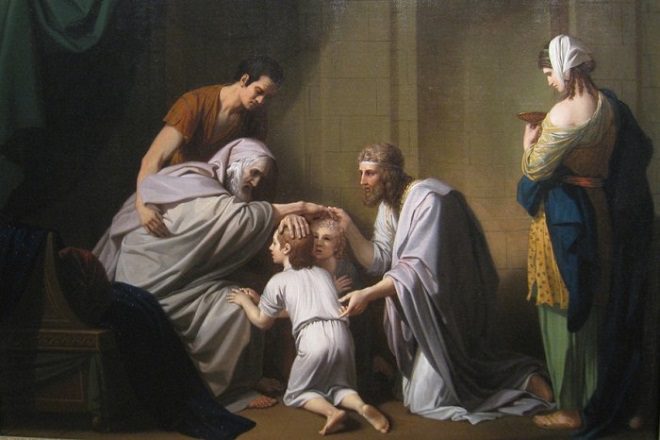
Most indicators have a logical relationship ‎with their mathematical function, for instance:‎“et” = add, “not” = disregard, “on the head” = ‎the first syllable of a word, “bruise” = put two ‎words together, “the heel” = the end syllable of ‎a word.  So we’re going to be taking you on a bit of a whirlwind tour around the Torah, to alight on some of the common conventions of biblical gematria.  As promised, today we’re going to look at an unusual bit of gematria in the story of Ephraim and Manasseh; Genesis 48:14.

This calculation has something of the feel of a cryptic crossword clue about it.  When we read it we should be looking for logical relationships ‎between the words in the sentence:

וישלח ישראל את־ימינו וישת על־ראש אפרים והוא הצעיר ואת־שמאלו ‏על־ראש מנשה שכל את־ידיו כי מנשה הבכור

“But Israel stretched out his right hand and laid ‎it on the head of Ephraim, who was the younger, ‎and his left hand on Manasseh’s head, crossing ‎his hands, although Manasseh was the firstborn.”‎

The value of the names are exactly the same, until just ‘the head’ of the names are considered;

מְנַשֶּׁ֖ה הַבְּכֽוֹר ‘Manasseh the firstborn’ = 331
 אֶפְרַ֙יִם֙ ‘Ephraim’ = 331

Israel is touching both Ephraim and Manasseh which indicates the sum of the three names are to be added, but the text specifies that he is only touching them  עַל רֹ֤אש “on the head” which by convention means we should add ‎‎‘the head’ or first parts from each name, therefore we take the Peh and Aleph from Ephraim and the Mem from Manasseh:

יִשְׂרָאֵ֨ל‎ ‘Israel’ (244) + (‎‏(81) אֶפְ‎ of  ‎‏(אֶפְרַ֙יִם֙‎ + (‎‏ (40) מְof ‎מְנַשֶּׁ֑ה‎) = 365 (days).

And now we may ask ourselves “Why is the number of days in a year relevant to the story of Manasseh and Ephraim?”   Much of the gematria in Genesis concerns the Solar and Lunar cycles, and we see the number 365 appearing many times in Genesis as the text discusses the cycles of the solar year.  It’s first seen in Genesis 1:2-3;

365 = פְּנֵ֣י תְה֑וֹם – וְחֹ֖שֶׁךְ + אֽוֹר
“The Face of the Deep” – “and darkness” + “light” = 365

We see 365 again in Genesis 3:3;

ומפרי העץ אשר בתוך ־ הגן
“And the fruit of the tree which in the middle of the garden.

[In my experience of the calculating art, typically the use of the words such as בְּתוֹךְ ‘middle’ or ‘’between’ denotes the function of division by 2 of the following noun, which in this case is הגן ‘garden’ 58. Therefore: 58 / 2 = 29 and when we add this to ומפרי ‘and the fruit’ 336 results in 365 (days in a year).]

365 is central to the story of Jacob and Esau [Genesis 25:27];

עֵשָׂ֗ו + צַ֖יִד + יַעֲקֹב֙

Esau 79 + hunter 104 + Jacob 182 = 365

This story in particular has strong typological similarities to the 3rd millennium BCE Sumerian text The Debate between Winter and Summer.

365 is a significant number to the Seven Palaces.  When the sum of the middle column is calculated (282 if we do not ‎use gates) and then removed from the total number (1012 ‎for the entire wheel) this leaves 730 and also splits the ‎wheel into two sections.

730 = 365 days + 365 nights.

When the letters Yod and Ayin are doubled on their paths we find the total sum from the Palace of the Aleph to the Palace of the Daleth is 365;

Aleph (1) + (Yod x 2 (20)) + Resh (200) + (Ayin x 2 (140) + Daleth (4) = 365.

And we also find the same calculation with the opposite diagonal;

Aleph (1) + (Lamed x 2 (60)) + Resh (200) + (Nun x 2 (100) + Daleth (4) = 365.

Lastly, the Talmud Yerushalmi Tractate Rosh Hashanah ‎‎2:5 says:

”The Holy One blessed be He ‎created 365 windows that the world might ‎use them:  182 in the east, and 182 in the ‎west and one in the center of the firmament ‎from which it came forth at the beginning of ‎the Creation.”‎

That’s it for today.  Continuing on tomorrow I’ll be discussing how the ancients thought about light, as well looking into the story of the expulsion of Adam and Eve from the Garden of Eden.  So stay tuned for more numerical honey.

ABOUT THE AUTHOR Bethsheba Ashe is almost Scottish. She was born a Geordie in the North East of England but she currently lives 3 thousand miles away in Pennsylvania. She started writing and self-publishing in 1992, with a series of magazines. She is the author of several non-fiction titles such as "Chariot", and has recently published her first adventure/murder mystery novel. She also coded and runs the gematria calculator app "Shematria". Bethsheba is an inventor and her invention is 'Galay'; which is the worlds first dual logographic and alphabetical writing script. Currently she is coding an app for Galay messaging. She's a quiet but intensely curious human being who likes to keep busy and she loves animals.

Filed Under: Gematria, Merkabah Wheel Tagged With: biblical, Eden, Ephraim, Garden of Eden, Gematria, Genesis, Jacob, Manasseh

The Gematria of Man

November 19, 2018 By BethSheba Ashe Leave a Comment

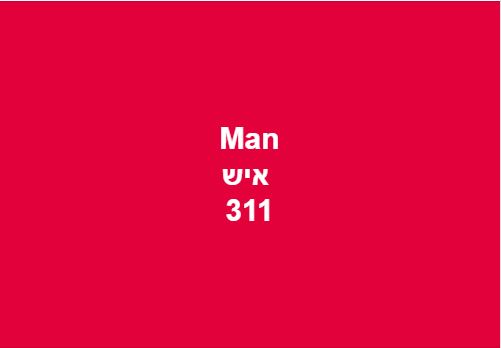
One of the consequences of studying the gematria of the bible is that I look at this and instantly count the proper value of 14 for the hebrew word for ‘man’.  AISh ~ Aleph = 1, Yod = 10 and Shin = 3.

One of the other consequences of studying the gematria of the bible is that the number of a word is of very little consequence to me, unless it is used in a deliberate biblical calculation somewhere in the Torah, or in subsequent Jewish writings.

On its own, the word (any word) stands in a void of isolation; bearing no relationship to other actors. It is simply a word and a number. Most of the time there is no intrinsic relationship between words that share a common number. When chance coincidences occur, the whimsy of these things can delight me when I see the role that chance and randomness play in our imaginations. But I don’t take it as a serious method of biblical analysis.  It’s not “the Sod”.  For instance this;

יאש  Meaning: to desist, i. e. (figuratively) to despond. Usage: (cause to) despair, one that is desperate, be no hope.

…this word ‘IASh’ also has a gematria value of 14, but are we to take the rather gloomy prophecy from this that man is a hopeless case because the number of the word man shares its digits with that of IASh? Come on… it really is utter nonsense, isn’t it?  At best it’s a form of imaginative numerical doodling that can randomly stimulate creative ideas.  You can do the same thing watching clouds though.

So if you want to study the hebrew language, why not take a look at their words in context?  The first incidence of AiSh in the Torah, that is without other prefix and suffix letters, occurs in Genesis 2:24:

על כן יעזב איש את אביו ואת אמו ודבק באשתו והיו לבשר אחד׃

It says “There-after will leave a man (+) his father and (+) his mother and join in his wife, and become to flesh one.”

Go and study the interlinear text for a while and come back to this.

https://biblehub.com/text/genesis/2-24.htm

All done?  Right.

If we consider the logic of the relationships of the actors to one another; clearly the sum of the man must be subtracted from the sum of his mother and his father, but his sum is joined to that of his wife.

My working hypothesis is that the text is disclosing the calculation of an intercalary 13th month.  To keep a 12-month lunar year in pace with the solar year, an intercalary 13th month would have to be added on seven occasions during the nineteen-year period (235 = 19 × 12 + 7).  When Meton introduced the cycle around 432 BC, it was already known by Babylonian astronomers.

Gematria Numbers:

AiSh : Man = 14

BaShThv : In his wife = 16

AiSh BaShThv : Man in his wife = 30

Abiv : His Father = 19 (years)

Amv : His Mother = 47 (47 x 5 = 235)

LbShr : to flesh = 235 (a period of 19 years is almost exactly equal to 235 synodic months and, rounded to full days, counts 6,940 days. The difference between the two periods (of 19 years and 235 synodic months) is only a few hours, depending on the definition of the year.  19 × 12 + 7 = 235. )

Achd : One = 13 (an intercalary 13th month)

LbShr Achd : One Flesh = 248 (8 x 31).


The Calculations:

Abiv – AiSh = 3 : His Father – Man = 3

Amv – AiSh = 33 : His Mother – Man = 33

3 + 33 + BaShThv 16 = 52 (weeks in a year)

3 + 33 + BaShThv 16 + Aish 14 = 66

One Flesh 248 – His mother 47 – His Father 19 = 182 (half a year/ winter/summer).

In verse 25 it says the man and his wife were naked עֲרוּמִּ֔ים (366) and not ashamed (18).  There are 366 days in an intercalary year.  366 is the sum of the ‘man’ and ‘in his wife’ in 2:24, when added to the remaining from the man being subtracted separately for his mother and his father + the letters Resh (200) and Qoph (100).  However, the bible uses the word HaAdam instead of AiSh ‘man’ in verse 25, which gives  וְאִשְׁתּ֑וֹ + הָֽאָדָ֖ם = 70 : The Adam and his woman = 70.

In the tarot, the letter Resh is attributed to ‘The Sun’ and the Qoph is attributed to ‘The Moon’.  The letters of Qoph and Resh are also attributed to these particular verses (2:24-25) of Genesis:

http://bethshebaashe.com/genesis-chapters-1-2-tarot

If Adam and Eve were personifications of the Sun and Moon, it would go a long way to explain the genealogy of Jacob and Esau (who personify the Summer and the Winter) later on in the Book of Genesis.  Were it not for tradition that insists upon treating these biblical characters first and foremost as human beings, the idea that seasons are descended from an impressive lineage like the Sun and the Moon, is far easier to swallow than the idea that the seasons came from human beings.


In case you haven’t heard yet; you can now use the Shematria biblical calculator to help you explore the bible with gematria!  Shematria is coded using the original paleo-hebrew sourced gematria that the bible was originally written in.  So make sure that you bookmark that for future reference.

Please consider donating to the app, so that I can continue to update it with features like a Greek database, or opening up a users only area.  Thank you.

Filed Under: Gematria Tagged With: 2:24, adam, AiSh, biblical, cycle, Gematria, Genesis, man, Metonic

Ezekiel’s “living creatures”…

February 2, 2018 By BethSheba Ashe Leave a Comment

http://bethshebaashe.com/wp-content/uploads/2018/02/Ezekiel-Part-One-3.mp4
The biblical text that is most associated with the Divine Chariot is Ezekiel; who gives an account of a vision where there were wheels inside of other wheels, and a living creature of four faces; that of an ox and a lion and an eagle and a man.  The vision is actually a calculation to indicate that the living creature had the numerical likeness of Abraham (248).

——————————————————-

Before we get to that, we’re going to be looking closely at ‎the Hebrew letters and the part they play in Jewish mythology about the creation of the world and in ‎what is called the secrets of the Torah.‎

‎The Mishnah tells us that these secrets are “the esoteric Act of Creation and the Act of the ‎Divine ‎Chariot,” and it adds “which should remain hidden”.‎

The Tree of Life – showing Malkuth being added to Yesod – Portae Lucis, Augsberg 1516.

A thousand years after the Mishnah, Kabbalah was invented. Although you’ve probably read, and it is ‎popularly cited that Kabbalah is Jewish mysticism, it’s actually a rather elaborate cipher for a type of ‎secret biblical exegesis known as ‘the Sod’. We won’t be discussing Kabbalah, but I note that we’ll be ‎discussing a branch of knowledge that Kabbalah is a cipher for.‎

The Sod was one of 4 methods of biblical exegesis known to and used by the Tannaim. These were the ‎Rabbinic sages whose views are recorded in the Mishnah, from approximately 10-220 CE. The 4 ‎methods of biblical exegesis were called by the acronym ‘the PaRDeS’ (Orchard). It stood for:‎

P for a Plain (Peshat) interpretation of the Bible.‎
R (Remez) for a symbolic interpretation just under the plain sense of the text. Remez means ‘hint’.‎
D for Derash means “inquire” and refers to comparative interpretation.‎
Sod (pronounced sode) is the secret method of biblical interpretation. ‎

The secret method was concerned with the conformations of the Universe as the ancient semitic ‎peoples thought of them. They called this ‘the Divine Chariot’ and they imagined that it existed prior ‎to the creation of the heavens and the earth by God. They imagined that God sat upon this chariot and ‎rode around in the clouds on it causing the storms.

Ezekiel refers to this Wheel, but it’s also called ‘the ‎Seven Palaces’ in texts such as the Hekhalot. According to their ancient way of thinking, they believed ‎God used 22 letters to create the world with, and these 22 letters were each attributed to separate ‎sections of the wheel that moved the Divine Chariot.
‎
In the Genesis account of creation, the 22 letters are attributed to the first two chapters, but the order ‎of the letters in the alphabet are different from what they are today, and that’s because Genesis was ‎created in a different Hebrew writing script.‎

The Jewish King Ezra changed the official writing script of his people from Paleo-Hebrew to Ashuri in the 6th ‎Century BCE. Ashuri has 27 characters, but Paleohebrew has only 22; one for each letter. Ashuri has a ‎number set from 1-1000 but Paleohebrew has a number set from 1-200. A peculiarity about the ‎Paleohebrew script number set, is that it has two letters with the value of 3, and another two letters ‎with the value of 4. A lack of numerical linearity was justified by the final total of the order of the ‎count (217) because it was a divine number – being seven times the number of EL (God); the creator.‎

‎1 + 2 + 3 + 3 + 4 + 4 + 5 + 6 + 7 [ … and so on] 18 + 19 + 20 = 217.‎

So this is the way that the paleohebrew alphabet is attributed to the verses of Genesis chapters 1 & 2 (from right to left): ‎

Gematria Key:‎
א 1 ב 2 ג 3 ש 3 ד 4 ת 4 ה 5 ו 6 ז 7 ח 8 ט 9 ‏
י 10 כ 20 ל 30 מ 40 נ 50 ס 60 ע 70 פ 80 צ 90 ק 100 ר 200‏

Studying Genesis can tell you about the qualities that each letter contributed to the creation of the ‎heavens and the earth. If you use these numbers to study the gematria of Genesis you’ll discover ‎various matters concerning astronomy (not astrology) and the calendar recorded within the text.

The ‎number set was also transposed to the Greek script so certain Christian texts (such as 1 John) carry this ‎subset of mathematical information used by the Sod to interpret the text with.

There are many great online programs that can help you learn the 22 letters of the alphabet in under ‎an hour. I’d recommend the this Hebrew Quizlet;https://quizlet.com/222209/hebrew-alphabet-flash-‎cards/‎

You could also make your own and add the letter values to them, or even make scrabble-tiles to help ‎you count Hebrew words.‎

———————–

Ezekiel’s Numerical Arte.

The calculations that reveal Ezekiels “living creatures” to have the likeness of Abraham are located in Ezekiel 1:10:

Consult this diagram of the Seven Palaces for this next part, and I’ll show you why….

The Seven Palaces
The Seven Palaces

Ezekiel 1:10
ודמות פניהם פני אדם ופני אריה אל־הימין לארבעתם ופני־שור מהשמאול לארבעתן ופני־נשר לארבעתן

And the likeness of their faces, the face of a man and the face of a lion on the right side [of the word] to them four and had the face of an ox to the left [of the word] to them four and had the face of an eagle to them four.

Man = אדם = 45 = the gate of Mem.‎

Lion = ‎אַרְיֵ֤ה‎ = 216 on the right side of the word = ‎אַרְיֵ֤‎ = 211 (gate of the ‎path of Yod).‎

Ox = ‎שׁ֥וֹר‎ = 209 on the left side of the word = ‎וֹר‎ = 206 (gate of the path ‎with four letters; ‎(‎שתצק)‎ Shin, Tav, Tsade & Qoph).

Eagle = ‎נֶ֖שֶׁר‎ = 253:
For this one we collect the letters from all four paths and palaces connecting to the Palace of the Aleph on the right hand side of the wheel:

Chariot, by Bethsheba Ashe
Want to know more about the Merkabah?

‎1 Palace of the Aleph‎
‎9 Path of Teth + 1 the other Aleph = 10‎
‎6 The Vav + 2 the Palace of Beth = 8‎
‎20 The Kaph + 4 the Palace of Daleth = 24‎
‎10 The Yod + 200 the Palace of Resh = 210‎
‎1 + 10 + 8 + 24 + 210 = 253.‎

Therefore:
Man = Gate of Mem
Lion = Gate of Yod
Ox = Fourfold (‎שתצק‎) Gate
Eagles = Palace of Aleph
‎
Mem (40) Yod (10) Shin (3) Tav (4) Tsade (90) Qoph (100) Aleph (1) = 248, which is numerically identical with the value of Abraham (248).

It is as Rabbi Shimon ben Lakish once said: “The patriarchs they ‎themselves were the Divine Chariot!“

Filed Under: Gematria Tagged With: Abraham, alphabet, Ezekiel, Genesis, Greek, Isopsephy, Mishnah Kabbalah Merkabah Divine Chariot, New Testament, Paleohebrew, Seven Palaces, Torah Bible Gematria

What the apple really was… (spoiler alert – it wasn’t sex).

August 31, 2017 By BethSheba Ashe Leave a Comment

Introduction.
The bible is stuffed with apparently unexplained metaphors, which is one of the reasons why people have speculated over it for thousands of years; in the seeming absence of any type of clarification people have delighted in putting forward their own.  In the case of the fruit of the Tree of Knowledge, people have suggested that its a metaphor for the first nookie, or that the fruit gave intelligence to humans that separated them from animals, but these are just guesses.

Yet it is possible to discover what the fruit really was with gematria.  Gematria is the art of assigning numerical values to letters so that words can be calculated as part of a mathematical sum.  But to discover the secret level of meaning (the ‘sod’[1]) of the bible, you have to use the right gematria.  This has (until relatively recently) always been a carefully guarded secret however, so the chances are that you’ve never heard of it before.

The gematria of the Torah was an intrinsic part of the Merkabah[2], but it became a forbidden topic of conversation for Jewish people after the second century C.E. Judah the Patriarch (who edited the Mishnah) banned all discussion of the Merkabah[3] and so the gematria values published in the Talmud and the Mishnah are wrong for the Torah; infact they are a deliberate blind intended to throw eager seekers of the Torah’s hidden level of meaning off the scent.

Academics today generally hold any sort of gematria in disrepute, having lazily assessed the wrong numerical values and inevitably found them wanting, but to date there has been no study of the gematria of the Merkabah, and therefore scholars have nothing to say on the matter.  Nevertheless there have been better scholars that believe there is gematria in the bible[4], and they trace the origins of the practice to Mesopotamia where it was first used with the cuneiform script.  The gematria of the Merkabah was first discovered in the last century by the self styled occult magician ‘Aleister Crowley’ and by myself in 2014 after a careful study of the Zohar’s ‘Book of Concealed Mystery’ which contains a riddle – the solving of which reveals the Seven Palaces[5].  This diagram is an alpha-numeric logo-graphic arrangement.  It contains the letters of the Hebrew alphabet assigned to Palaces (similar to sephiroth) and Paths, and it allows us to decipher the hidden gematria of the Merkabah [6]:

א 1 ב 2 ג 3 ש 3 ד 4 ת 4 ה 5 ו 6 ז 7 ח 8 ט 9 י 10 כ 20 ל 30 מ 40 נ 50 ס 60 ע 70 פ 80 צ 90 ק 100 ר 200

Main.
To discover the identity of the fruit of the Tree of Knowledge we need to consult בְּרֵאשִׁ֖ית (Genesis) 3:3.   You can check the following calculations by following the link, and even if you don’t know how to read or speak hebrew you can still study the gematria of the Torah using the modern interlinear feature.  Not to sound too much like the mouse in Disney’s Ratatouille – but everyone can count.  You need to memorize the 22 letters and numbers above, and that’s it!  You’re ready to roll.  Not too difficult, is it?

“And the fruit of the tree which in the middle of the garden”. – Genesis 3:3
ומפרי העץ אשר בתוך ־ הגן

In my experience of the calculating art, typically the use of the words such as בְּתוֹךְ ‘middle’ or ‘’between’[7] denotes the function of division by 2 of the following noun, which in this case is הגן ‘garden’ 58. Therefore: 58 / 2 = 29 and when we add this to ומפרי ‘and the fruit’ 336 results in 365 (days in a year).

In the rest of the verse Eve says to the serpent “God has said, ‘You shall not eat from it or touch it, or you will die.’”  This is couched in mathematical metaphor with ‘eating’ being ‘to subtract’ from the number while just ‘touching’ is ‘to add’ to the number.  But in any case the prohibition is against altering the 365 day year in any form because the light of days was divinely decreed to fall to earth.  The garden of Eden was situated above the earth in a realm that was before (and after) manifestation on the cosmos of the Seven Palaces.  Therefore when Adam and Eve ate the fruit of the Tree of Knowledge they had to descend with the light of days to earth, and all beings that descended to earth were subject to the cycle of death and reincarnation.

When הָֽאִשָּׁ֡ה ‘the woman’ 14 and לְאִישָׁ֛הּ ‘to the man’ 49 is subtracted from 365 (through the eating of the fruit in 3:6) it results in 302, which when converted from base 60 to decimal[8] = 182.  182 which is the length of Summer and the sum of the name of Jacob[9].

365 – 45 אדם (Adam) is 320 עֵירֹ֥ם ‘naked’, a state which Adam finds himself in Genesis 3:10.  Conversion of 320 from base 60 to decimal gives 200 which is עֵֽינֵיכֶ֑ם ‘your eyes’ 200 in Genesis 3:5, where the serpent promises Eve that their eyes shall be opened should they eat the fruit.

They are כֵּֽאלֹהִ֔ים ‘as gods’ in the sense that have become the personifications of the Summer, and they know ט֥וֹב ‘good’ 17 + וָרָֽע ‘and evil’ 276 = 293 because their eyes have been opened.  Whereas in their unenlightened state, they knew only God because 293 – 200 = 93 = 31 אל x 3, they have gained the light of the Sun (the Resh 200).

Conclusion.
Unlike other numerical systems, the gematria of the Merkabah actually works to decipher the hidden meanings of the Tanakh (Old Testament).  Therefore it is something of a Black Swan in today’s world because it is surprising and completely unlooked for, yet capable of causing a deep and systematic change in the way that people of all Abrahamic religions understand the bible.

In the case of the gospels, it can be unambiguously shown that the Book of John used the gematria of the Merkabah transposed over to the Greek script, so it is not something that is confined to Jewish books but affects Christians and Muslims too.  The NT shows that Jesus was 12 hours worth of daylight!

Until relatively recently it could not have been appreciated just how many verses of the Tanakh and the NT were not intended to be read, but counted instead.  Frequently the results thrown up by the Merkabah argue against reading the open text of the bible in a literal fashion; either as a historical document or a collection of stories about the ancestors of the Jewish people, because the characters in these stories (including Abraham, Sarah, Jacob, Joseph and Jesus) appear as personifications of natural forces or periods of time.

It may seem ironic, but the most widely read book in the world of all time, is the most misunderstood and misinterpreted.  The scribal authors were discussing ethics, sociology, duty, good and evil, and asking questions such as ‘what happens after we die’? Does God actually give a shit? How should we live and what is brotherhood and sisterhood all about? What does ‘family’ really mean? And at the same time they were intellectually curious men who were fascinated with the revolutions of the stars and the orbits of the planets at a time when no-one could prove what they were but everyone had a theory…

I think that still deeply resonates with most people, because if we’re all completely honest – there’s a lot of stuff like that; no-one can prove what happens after you die or if there’s a quantum God or if we get reincarnated. So I actually find the Bible more interesting and instructive than before when I did read the thing more literally and didn’t have the keys to read it properly.

What people read into the bible tells us something about ourselves, but after 2,000 years of such self-absorption, isn’t it time that we as a species finally discovered what the ancients were actually saying?

—————————-
There is a limit to how much I can write in a blog, but if you have found this essay interesting you may enjoy my book ‘Chariot’ which is available on Amazon.  https://www.amazon.com/Chariot-Bethsheba-Ashe/dp/1530524431/

———————————————————————————————————
[1]   Strong’s definition: “assembly, counsel, inward, secret counsel.
From yacad; a session, i.e. Company of persons (in close deliberation); by implication, intimacy, consultation, a secret – assembly, consel, inward, secret (counsel)”:
http://biblehub.com/strongs/hebrew/5475.htm

[2]   Reader’s Guide to Judaism, by Sarah Pessin, page 457: https://tinyurl.com/ycb6gcca

[3]   The Faces of the Chariot: Early Jewish Responses to Ezekiel’s Vision, by David Joel Halperin, page 14:
https://tinyurl.com/ybwslfqa

[4]   Lieberman concludes that, given the employment of numerological techniques before and during the composition of the Hebrew Bible, it is entirely possible that Gematria was employed in the biblical text itself, encoding hidden messages.  A Mesopotamian Background for the So-Called Aggadic ‘Measures’ of Biblical Hermeneutics?, by Stephen J. Lieberman, Hebrew Union College AnnualVol. 58 (1987), pp. 157-225:
https://www.jstor.org/stable/23508256

[5]   The Seven Palaces are at the core of Merkabah literature.  Kabbalah came about largely in response to the prohibition upon free study of the Merkabah, and the Seven Palaces was derived into the Tree of Life so that students could discuss the Merkabah in an enciphered fashion.
http://bethshebaashe.com/conformations-tree-life

[6]   A mathematical analysis of the Seven Palaces shows an interplay of numbers upon each of the faces, with each depending on the others for support and existence, and conveys a sublime insight into the interdependent functioning of the cosmos as well as providing a checksum for the gematria.  See the link above for an illustration of the Seven Palaces.

The reason why there are two incidences of the value 3 (gimel and shin) and 4 (daleth and tav) is because the number system is logo-graphically keyed to the closed cosmological system of the Seven Palaces and was not constructed as an open number system.  With all the letters in the correct placement then the order of the alphabet sums to 217:

1 + 2 + 3 + 3 + 4 + 4 + 5 + 6 + 7 + 8 + 9 + 10 + 11 + 12 + 13 + 14 + 15 + 16 + 17 + 18 + 19 + 20 = 217.
– which was of great significance to the ancients being:
1.  אל  – ‘El’ (31) x 7 = 217.
2.  The gematria of the Seven Palaces = 217; [Beth (2) + Aleph (1) + Aleph (1) + Resh (200) + Dalet (4) + Dalet (4) + Heh (5)].
3.   The gematria of the Holy of Holies = 217; [Beth (2) + Gimel (3) + Heh (5) + Zayin (7) + Resh (200)].

Please scroll to the bottom of the page to see a chart illustrating how the gematria of the Merkabah’s Paleohebrew script was wrongly converted into the ‘Standard gematria’ of the Ashuri (square) script, and thus hidden from general discovery:
http://bethshebaashe.com/sarah-and-abraham

[7]  If something or some person is “between” בֵּ֣ין some other thing or person then the scribe is trying to tell you to halve the value of whatever is between.

For instance:  ויבא בין ׀ מחנה מצרים ובין מחנה ישראל ויהי הענן והחשך ויאר את־הלילה ולא־קרב זה אל־זה כל־הלילה

“So it came between the camp (103) of Egypt (380) and the camp (103) of Israel (244); and there was ‘the cloud and darkness’ (217), it lightened (217) ‘ath’ the night (80). Thus the one did not come near the other all night (80)”. – Exodus 14:20.

In this sum we begin by dividing Egypt and Israel in two – ‘getting between’ them:
Egypt 380 / 2 = 190
Israel 244 / 2 = 122.
190 + 122 + 217 ‘the cloud and the darkness’ + 217 ‘it lightened’ – 80 ‘the night’ = 666.

[8]  In some texts of the bible, it is common for Hebrew scribes to employ this type of conversion.  Modern people still use base 60 for time measurement, thus 3:02 minutes (base 60) is 182 seconds (decimal).  It was originally invented by the Babylonians:
https://en.wikipedia.org/wiki/Babylonian_numerals

[9]  The seasonal character of Esau and Jacob as the personifications of Winter and Summer start at Genesis 25:27:

ויגדלו הנערים ויהי עשו איש ידע ציד איש שדה ויעקב איש תם ישב אהלים

“When the boys grew up, Esau(79) became a skillful hunter (104), a man(14) of the field(12), but Jacob(182) was a peaceful man, living in tents(26).”

Esau 79 + hunter 104 = 183
Jacob = 182
183 + 182 = 365 (days in a year)
Man + Field = 26
Tents = 26
26 + 26 = 52 (weeks in a year).

The origin of the story is Mesopotamian – typological to the Myth of Emesh and Enten (The Debate between Winter and Summer) which was recorded during the mid to late 3rd millennium BC.

http://bethshebaashe.com/the-winter-and-the-summer

Filed Under: Gematria Tagged With: Apple, Bible, Creation, Fruit, Gematria, Genesis, Hebrew, Torah, Tree of Knowledge

  • 1
  • 2
  • Next Page »

Copyright © 2025 · BethSheba Ashe · Log in