BethSheba Ashe

Author & Researcher in the Original Gematria and the Precursor to the Tree of Life

You are here: Home / Archives for BethSheba Ashe

Sarah and Abraham

August 17, 2017 By BethSheba Ashe Leave a Comment


In the Book of Genesis, Elohim changes the name of Sarah and her husband Abraham from Sarai and Abram, and this gives the gematria of their names a different value.  Sarai 213 became Sarah 208 (-5) and Abram 243 became Abraham 248 (+5).  Not coincidentally each name is concordent to a span of time; with 208 weeks being exactly 4 years and 248 days being 9 anomalistic months.  In each verse where the name change occurs, the value of the justification for the name change equals that of the name; Abraham (248) = המון גוים נתתיך ‘of many nations I have made you‘ (Genesis 17:5).

‘Then Elohim said to Abraham, “As for Sarai your wife, not call her the name Sarai, for Sarah the name.  I will bless her, and indeed I will give you a son by her. Then I will bless her, and she shall be a mother of nations; kings of peoples will come from her.” ” –Genesis 17:15-16.

שָׂרַ֣י Sarai 213, שָׂרָ֖ה Sarah 208,
(Not included in this verse: הָגָ֖ר – ‘Hagar’ 208; יִצְחָ֑ק – ‘Isaac’ 208; ישראל Israel 244).
213 Sarai  + 31 Shall come = 244.
30 And she shall be + 89 of Nations  + 100 Kings + 160 of people – 135 from her = 244.

Shall be her name 48 + of people 160 = 208.
247 And I will bless + 30 She shall be + 89 of Nations = 366 (days in a leap year).

We see Abraham’s value of 248 first pop up in Genesis 1:4 with הָא֖וֹר + הַחֹֽשֶׁךְ = ‘the Light’ + ‘the darkness’ = 248, but also the value of Israel 244 is made through calculations in Genesis 1:2-3 from א֑וֹר Light 207 + וחשך and darkness 37 = 244.

248 reoccurs in 1 Kings 6:7 with שְׁלֵמָ֥ה + מַסָּ֖ע = ‘made ready’ + ‘at the quarry’ = 248:

The house, while it was being built,was built of stone made ready at the quarry, and there was neither hammer nor axe nor any irontool heard in the house while it was being built.

The sum of the names of Abraham, Isaac and Israel = 700. This sum is first seen in Genesis 1:1

1 בראשית 220 ברא 203 אלהים 86 את השמים 98 ואת הארץ 296׃

220 In the Beginning + 86 Elohim + 98 Heavens + 296 Earth = 700.

The word for ‘days’ יָמִ֖ים = 100 so 7 x 100 = the Seven Days of Creation, therefore when the scribe refers to the God of ‘Abraham, Isaac and Israel’ he is specifically revering the God of Creation by his numerical art.

Likewise to the mandean justification of the name of Abraham, we see the same occurring in Genesis 32:28 for the name of Israel (244):

שָׂרִ֧יתָ You have struggled = 217

אֱלֹהִ֛ים God = 86

אֲנָשִׁ֖ים Men = 104

(217 – 86) + (217 – 104) = 244.

Essentially then, the scribe is referencing different names in order to get the right numerical value for the calculations he is setting out.

When it comes to names in the bible then, we must always be a little suspicious of the text. The Hebrew people most likely learned the practice of gematria from the Mesopotamians[1], and mandean style calculations with names are extremely common in the Tanakh (Old Testament).


[1] Stephen J. Lieberman: ‘A Mesopotamian Background for the So-Called Aggadic ‘Measures’ of Biblical Hermeneutics?’ https://www.jstor.org/stable/23508256


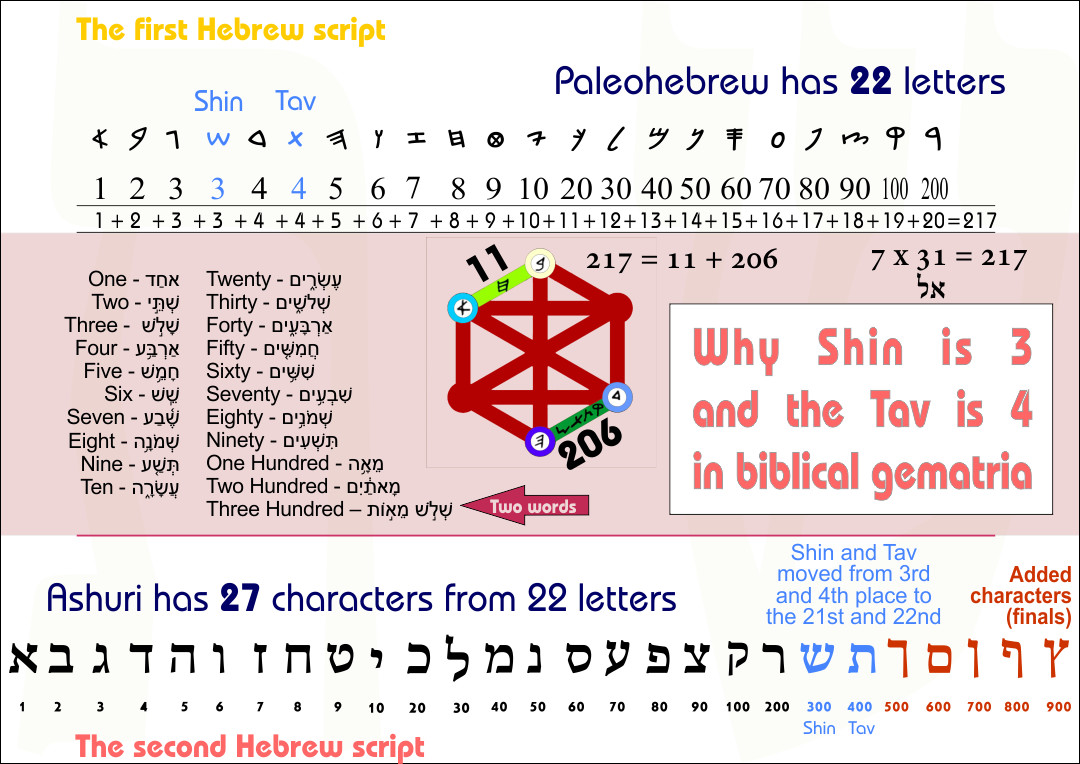
Note – all values are calculated with Paleohebrew gematria, which is almost the same as Standard
except that the shin = 3 and the tav = 4.  For a discussion about Paleohebrew gematria used with the Greek script and the New Testament please click this link…
Filed Under: Gematria Tagged With: Abraham, Gematria, Leap Year, Paleohebrew, Sarah

Merkabah

August 12, 2017 By BethSheba Ashe Leave a Comment

Or not?

Have you heard of the phrase ‘activating your ‎Merkabah’?
Do you think the Merkabah is a ‎Chariot of Light that will
help you ascend to ‎the realm of the divine if you learn
enough ‎Yoga and activate all your Chakra’s?

Perhaps you’ve bought Merkabah Jewelry? Or do you have ‎a special Merkabah candle to burn while you ‎surf the astral?

Drunvalo Melchizedek.

Fake news is not just a problem for the popular ‎press.  Popular knowledge of the Merkabah is ‎swamped by a plastic rainbow hippy amalgam ‎of Indian Kundalini Yoga, Greek Euclidian ‎Geometry and the insight of someone that was ‎very high on acid to fuse the two things ‎together with just a splash of etymology into ‎an interdimensional vehicle consisting of two ‎equally sized, interlocked tetrahedrals of light.‎

This might make a great backstory for a movie ‎but this just isn’t what the Merkabah is. This ‎alternate Merkabah didn’t exist until 1972 ‎when Drunvalo Melchizedek met Lucy in ‎California one summer. She brought a strange ‎man with her that told him there were three ‎missing atoms in the universe and he wanted ‎him to find them.‎   That was the beginning of the Drunvalo scam.

The Jews in the ancient near east didn’t know ‎anything about Chakra’s.  If you were able to ‎go back in time and visit an ancient student of ‎the Merkabah, and if you were to sit in asana ‎before him, he might express some concern for ‎your comfort. ‎ He would have no clue what you were up to.  He ‎might display admiration for your Merkabah ‎jewelry – but only if it was high enough quality.  And if you asked him about riding the chariot of ‎ascension to see YHVH he might think you were ‎quite mad.

For a start, the chariot wasn’t a ‎vehicle commanded by men; instead it was the way ‎that God made everything – the heavens and the ‎earth and everything in between.  God was ‎inaccessible – in a place that the ancients ‎thought was the farthest away place there was ‎‎– the pole star. Here he was guaranteed ‎complete privacy to dwell in a formless state of ‎bliss; utterly unknowable in his full glory by any ‎mortal man. Even to touch his earthly tabernacle was to be ‎struck dead[1]. However man was free to wander ‎the rest of God’s realm in his sleep, and all of ‎the earth when awake.

The role of man and ‎woman was as it had always been when they ‎had lived in God’s private pleasure garden in ‎the heavens; it was to tend to all of God’s ‎creations. And after they died they traveled to ‎the palace in the west which had a door into ‎the afterlife; and they would be tested and ‎returned to life on earth. This was how living ‎beings traveled the Merkabah; in daydreams ‎and night dreams, and through reincarnation. ‎Each being – both living and dead had their ‎own different relative position on the Chariot which ‎meant that the chariot was different for ‎everyone – but this didn’t mean there was a ‎separate Chariot for every living being.

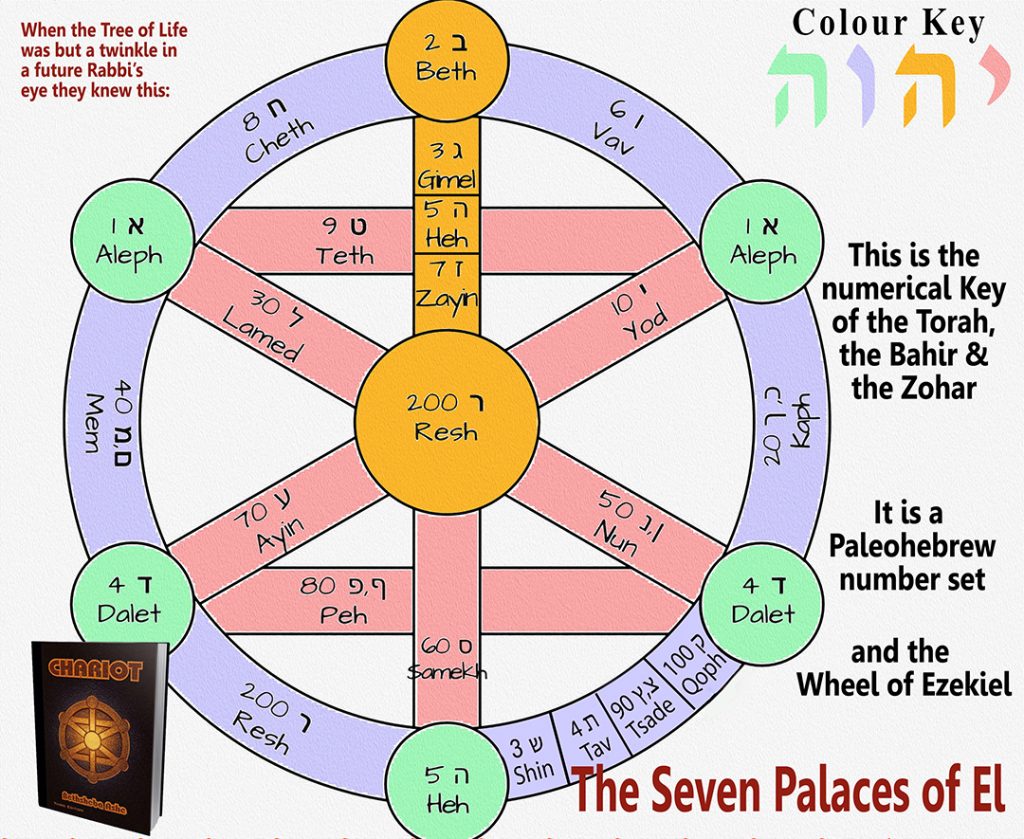
The ‎idea of multiplicity is derived from Ezekiel’s ‎description of ‘a wheel within a wheel’; ‎however this actually refers to the letters Teth.  The Paleohebrew sign also resembled a wheel and ‎Teth was the letter attributed to the face of the ‎‎‘the fiery waters of heaven’ – hashamayim. ‎

 The Sun, Moon, planets and stars were thought ‎of as living beings that swam in the vast waters ‎that we know today as space.‎

‎ “Whenever the living beings moved, the ‎wheels moved with them. And whenever the ‎living beings rose from the earth, the wheels ‎rose also […] for the spirit of the living beings ‎was in the wheels.” – Ezekiel 1:20.‎

By contrast, while we mortals may travel the ‎heavens and the earth in life and death – we do ‎so within the divine wheel of the vehicle of God ‎‎- and its motion causes life, death and the ‎passing of the seasons.‎

‎“Whenever those went, these went; and ‎whenever those stood still, these stood still. “‎

When a planet turns retrograde then it appears ‎from the earth to stop in the sky for a few days. ‎This is the planets stationary period before it ‎appears to travel backwards. This is an optical ‎illusion however.‎

‎“And whenever those rose from the earth, the ‎wheels rose close beside them; for the spirit of ‎the living beings was in the wheels.”‎

Don’t all planets appear to rise from the earth ‎during the night? Don’t they look a lot to you ‎like little wheels? Don’t the rays of light remind ‎you of spokes? This is why the face of the ‎heavens on the Seven Palaces is attributed to ‎the letter Teth.‎

So next time someone asks you what the ‎Merkabah is:- please please DON’T tell them ‎that Merkabah means Light Spirit Body? Or ‎that a Merkabah is counter-rotating fields of ‎light and spirals of energy which transport the ‎spirit-body from one dimension to another? ‎That stuff is cobbled together ‎snake-oil horseshit by a Californian guru trying ‎to make a buck.  It’s not Merkabah.

‎ ‎

Filed Under: Merkabah Wheel

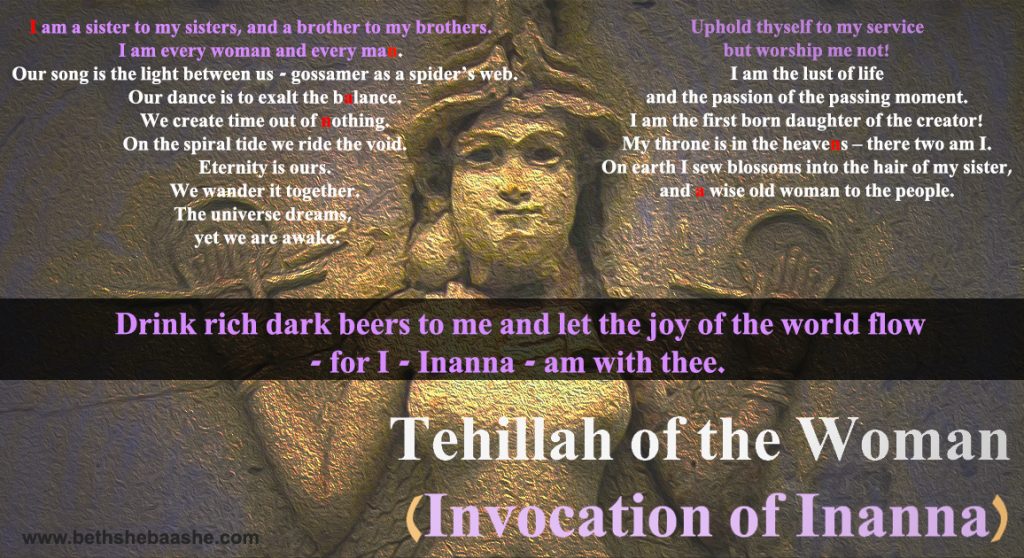
Tehillah of the Woman – (Invocation to Inanna).

August 5, 2017 By BethSheba Ashe Leave a Comment

(Invocation of Inanna. By Bethsheba Ashe (2017).
(Invocation of Inanna.
By Bethsheba Ashe (2017).

Filed Under: Uncategorized

Psalm 145:1-21 : A Fantastic Alphabetic Acrostic!

August 4, 2017 By BethSheba Ashe 1 Comment

Calculation, Frequency and Analysis of Psalm 145 with biblical gematria.

1.  Introduction.
2.  Gematria.
3.  Calculations.
4.  Frequency and Analysis.
5.  A Tour of the Afterlife.
6.  Conclusion.
7.  Footnotes.

1.  Introduction.

תהלה לדוד  A Psalm of Praise of David is the only chapter of the Book of Psalms that identifies itself as a תְּהִלָה (tehillah) – as a psalm (namely, a hymn of praise).  It is an alphabetic acrostic; the initial letter of each verse running in a Hebrew alphabetic sequence.  The book of Psalms overall contains eight alphabetic acrostics, four in book one and four in book five.[1]

One of Psalm 145’s peculiarities is that there is no verse beginning with the letter nun (נ).  The sequence skips from Mem to Samekh.  There have been various theories proposed for the reason behind this since the Third Century CE, but there is still no modern consensus of opinion on the matter.  The Septuagint, the Syriac Peshitta, and the Dead Sea Scrolls all provide a verse at this point, so I have included it as 13b in the commentary.  Psalm 145 appeared to be volunteering itself for a deeper examination of its contents through the lens of biblical gematria[2], and it didn’t disappoint.

The Talmud, Berakhot 4b[3] says of it: “If you say that it is because it is arranged alphabetically, then let us say: “Happy are they who are upright in the way” (Psalms 119*) where the alphabetical arrangement appears eight times.”

אשרי תמימי־דרך ההלכים בתורת יהוה *
“Happy are the upright in the way who walk in the laws of YHVH.“[4]

Concerning the missing Nun it adds “Additionally, with regard to this psalm, Rabbi Yoḥanan said: Why is there no verse beginning with the letter nun in ashrei? Because it contains an allusion to the downfall of the enemies of Israel, a euphemism for Israel itself. As it is written: “The virgin of Israel has fallen and she will rise no more; abandoned in her land, none will raise her up” (Amos 5:2), which begins with the letter nun. Due to this verse, ashrei does not include a verse beginning with the letter nun.”

 The Dead Sea scrolls version of Psalm 145 ends each of the 21 verses with the words: “this is for a memorial”, but it doesn’t say for whom it is a memorial for.  Benun has argued “that acrostics in Psalms are part of a sophisticated literary system which creates a series of signposts intended to guide the reader to each psalm’’s embedded message.”.[5]

As the text is ‘for a memorial’, it is my working hypothesis that the scribe sought to fix the way of the deceased with number magic.  I will show in my analysis that a substantial amount of gematria was carefully embedded into the verses and it’s my hypothesis that these numerical constructions are intended to function in a similar way to the spells of the Egyptian Book of the Dead.
Typological to the journey through the Duat, the deceased Hebrew traveled through the paths and pavilions of the lower section of the Seven Palaces.  These ‘Seven Palaces’ represented the cosmology of the world and it functioned as a type of Bhavacakra; allowing new and reincarnated souls into the world from doors at the east, and providing an exit for the dead through the door in the west.

Each Path and Palace of this arrangement was created by God (El-YHVH) with the qualities and numbers of the 22 letters.  The Hebrew word for symbol is ot, which, in early Judaism, denoted not only a sign, but also a visible religious token of the relation between God and man.  The number of things could represent quite abstract concepts as well as demonstrable qualia.  Thus (the theory goes) that instead of Egyptian spells that require things such as “nine apple seeds and your urine” (for example) – a simple number that reflected the good and harmonious ordering of the world was substituted.  Besides ‘fixing the way’ these numbers evoke a sense of divinely appointed order over the forces of chaos that may also have been a comfort to those grieving.

What I’ve sought to do below is to map out the gematria of the text and then narrow in on calculations that are most relevant to the value of each letter of the alphabet.  I’ve looked at the frequency of Major and Minor gates[6] and where they are found on the Palaces to see if there is a concentration of gate numbers that correspond with the journey of the deceased.  High frequency recurring numbers have also been flagged, as well as any values (such as gates) that are seen on the Seven Palaces[7].  Finally we shall take a tour of the afterlife as we try and understand what significance the numbers have to the newly deceased on his travels.


2.  Gematria.

Aleph  ארוממך אלוהי המלך ואברכה מך לעולם ועד

  1. I will extol (307) ALVHI (52), King (95), and bless (234) your name (60) forever (176) everlasting (77).

Beth  בכל־יום אברכך ואהללה מך לעולם ועד

  1. Every (52) day (56) I will bless (243) and praise (77) your name (60) forever (176) everlasting (77).

Gimel  גדול יהוה ומהלל מאד ולגדלתו אין חקר

  1. Great (43) YHVH (26), and praised (111) greatly (45), and his greatness (83) not (61) searchable (308).

Daleth  דור לדור ישבח מעשיך וגבורתיך יגידו

  1. Generation (210) to generation (240) shall praise (23) Your works (143) and your mighty acts (251) declare (33).

Heh  הדר כבוד הודך ודברי נפלאותיך אשיחה

  1. Honour (209) on the glorious (32) splendour (35) and works (222) of your wonder (201) shall I speak (27).

Vav  ועזוז נוראתיך יאמרו [וגדולתיך כ] (וגדולתך ק) אספרנה

  1. And of the might (96) of your terrible acts (291) they will say (257) and greatness (83) I shall declare (396).

Zayin  זכר רב־טובך יביעו וצדקתך ירננו

  1. Memory (227) great (202) goodness (37) they shall abundantly utter (98) and of your righteousness (224) shall sing (316).

Cheth  חנון ורחום יהוה ארך אפים וגדל־חסד

  1. Gracious (114) and compassionate (260) YHVH (26) slow (221) to anger (131) and great (43) of covenant loyalty (82).

Teth  טוב־יהוה לכל ורחמיו על־כל־מעשיו

  1. Good (17) YHVH (26) to all (80) and bringing mercy (270) over (100) all (50) his works (129).

Yod  יודוך יהוה כל־מעשיך וחסידיך יברכוכה

  1. Shall praise (46) YHVH (26) all (50) your works (143) and goodly ones (118) shall bless (263).

Kaph  כבוד מלכותך יאמרו וגבורתך ידברו

  1. Glory (32) of Malkuth (120) They shall Speak (257) and of your Power (241) talk (222).

Lamed  להודיע ׀ לבני האדם גבורתיו וכבוד הדר מלכותו

Isis Maat, Tomb of Siptah. Valley of the Kings.
Maat is the Goddess of Truth and Justice who personifies cosmic order and harmony as established by the Creator God at the beginning of time. Her symbol is an ostrich feather.
  1. To make atonement (125) to the sons of (92) the men (50) your mighty acts (231) and the majestic (38) splendor (209) of Malkuth (106).

Mem  מלכותך מלכות כל־עלמים וממשלתך בכל־דור ודור

  1. Your kingdom (120) kingdom (100) all (50) everlasting (190) and your dominion (143) in all (52) generations (210) and generations (216).

Nun נאמן אלוהים בדבריו וחסיד בכל מעשיו

   13b.  Faithful (141) Elohim (92) in words (224) and kind (88) in all (52) your works (129).

Samekh  סומך יהוה לכל־הנפלים וזוקף לכל־הכפופים

  1. Upholds (126) YHVH (26) to all (80) the fallen (215) and rises up (199) to all (80) the cast down (241).

Ayin  עיני־כל אליך ישברו ואתה נותן־להם את־אכלם בעתו

  1. The eyes of (140) all (50) the elect (61) await you (221) and you (16) give (110) like (75) plus (5) their food (91) in season (82).

Peh  פותח את־ידך ומשביע לכל־חי רצון

  1. Open (98) plus (5) Your hand (34) and satisfy (131) to all (80) living things (18) desire (346).

Tsade  צדיק יהוה בכל־דרכיו וחסיד בכל־מעשיו

  1. Righteous (204) YHVH (26) in all (52) his ways (240) and kind (88) in all (52) His deeds (129).

Qoph  קרוב יהוה לכל־קראיו לכל אשר יקראהו באמת

    1. Near (308) YHVH (26) to all (80) those calling (317) to all (80) that (204) call (322) in truth (47).

Resh  רצון־יראיו יעשה ואת־שועתם ישמע ויושיעם

  1. The desire (346) of the fearful (227) he will fulfill (88) and plus (11) their cry (123) he hears (123) and will save (145).

Shin  שומר יהוה את־כל־אהביו ואת כל־הרשעים ישמיד

  1. Preserves (249) YHVH (26) plus (5) all (50) those who love (24) and plus (11) all (50) wicked (328) he will destroy (67).

Tav  תהלת יהוה ידבר־פי ויברך כל־בשר שם קדשו לעולם ועד

  1. Praise (43) YHVH (26) will speak (216) my mouth (90) and bless (238) all (50) incarnate (205) name (43) holy (113) to forever (176) and ever (80).

3.  Calculations.

Aleph (1)  Line 1:  ALVHI (God) 52 + King 95 + your Name 60 = 207 (Light).
I will extol (307) – Light 207 = 100.
And bless (234) – 207 = 27
Forever (176) – everlasting (77) = 99
99 + 27 = 126.
100 – 99 = 1.

Beth (2)  Line 2:  Every (52) + day (56) – your Name (60) = 48
I will bless (243) – and praise (77) = 166
Forever (176) – everlasting (77) = 99
166 + 99 = 265.
265 – 48 = 217.
217 + 265 = 482.
Every (52) + day (56) + your Name (60) = 168
I will bless (243) – and praise (77) = 166
168 + 166 = 235
168 – 166 = 2 (Beth).

Gimel  (3)  Line 3:  Great (43) + YHVH (26) + and praised (111) + greatly (45) + and his greatness (83) = 308.
Searchable = 308.
Greatly (45) – Great (43) = 2
And praised (111) – YHVH (26) – And his greatness (83) = 2
And praised (111) + YHVH (26) + And his greatness (83) = 220
And his greatness (83) – not (61) = 22
Great (43) +  and praised (111) – greatly (45) – and his greatness (83) = 26
Great (43) + and praised (111) + greatly (45) + and his greatness (83) = 282
Greatly (45) + Great (43) + YHVH (26) + And his greatness (83) – and praised (111) = 86 (Elohim)
And praised (111) = 1 + 1 + 1 = 3.

Daleth (4)  Line 4:  Generation (210) + to generation (240) + shall praise (23) + Your works (143) + and your mighty acts (251) + declare (33) = 900.
Generation (210) + to generation (240) = 450.
Shall praise (23) + Your works (143) + and your mighty acts (251) + declare (33) = 450.
To generation (240) – Generation (210) = 30
And your mighty acts (251) – Your works (143) – shall praise (23) – declare (33) – 30 = 22
22 = 2 + 2 = 4.

Heh (5)  Line 5:  Honour 209 + Splendor 35 = 244 (like Israel).
Honour (209) + splendour (35) – shall I speak (27) = 217
And works (222) – of your wonder (201) + shall I speak (27) = 48.
On the glorious (32) – shall I speak (27) = 5.

Vav (6)  Line 6:  And of the might (96) + of your terrible acts (291) + they will say (257) – I shall declare (396) = 248.
(They will say (257) + I shall declare (396)) – (And of the might (96) + of your terrible acts (291) + and greatness (83)) = 183.
I shall declare (396) – And of the might (96) – they will say (257) + greatness (83) = 126.
I shall declare (396) + and greatness (83) – they will say (257) = 222 = 2 + 2 + 2 = 6.

Zayin (7)  Line 7:  Memory (227) + great (202) + goodness (37) + they shall abundantly utter (98) – shall sing (316) = 248.
Memory (227) – and of your righteousness (224) = 3.
Great (202) + goodness (37) + they shall abundantly utter (98) – shall sing (316) = 21.
21 / 3 = 7.

Cheth (8)  Line 8:  Gracious (114) + and compassionate (260) + YHVH (26) = 400.
Slow (221) – to anger (131) + and great (43) + of covenant loyalty (82) = 215
Slow (221) – to anger (131) – of covenant loyalty (82) = 8 (Cheth).

Teth (9)  Line 9:  Good (17) + YHVH (26) + to all (80) + his works (129) = 252.
Over (100) + all (50) + his works (129) = 279.
279 – and bringing mercy (270) = 9 (Teth).

Yod (10)  Line 10:  Shall praise (46) + YHVH (26) + your works (143) = 215
Shall bless (263) – and goodly ones (118) = 145
215 – 145 = 70.
Shall praise (46) + YHVH (26) + your works (143) – and goodly ones (118) + shall bless (263) = 360.
Shall praise (46) – YHVH (26) + your works (143) = 163
Shall bless (263) – 163 = 100.
100 + YHVH = 126.

Kaph (20)  Line 11:  They shall Speak (257) + and of your Power (241) + talk (222) = 720.
720 – Malkuth (120) = 600 = Kaph x 30.
Malkuth (120) – Glory (32) + talk (222) = 310.
720 – 310 = 410.
Malkuth (120) – Glory (32) = 88.
Glory (32) + talk (222) = 254.
Talk (222) – (They shall Speak (257) – and of your Power (241)) = 206.
talk (222) – of Malkuth (120) – Glory (32) = 70
They shall Speak (257) – and of your Power (241) = 16
70 + 16 = 86.

Lamed (30)  Line 12:  To make atonement (125) + To the sons of (92) = 217.
Your mighty acts (231) – splendor (209) = 22
To make atonement (125) + to the sons of (92) + the men (50) – and the majestic (38) – 22 = 207
To the sons of (92) the men (50) and the majestic (38) = 180.
Splendor (209) + of Malkuth (106) – To make atonement (125)  = 190
To the sons of (92) + the men (50) = 142
190 – 142 = 48

Mem (40)  Line 13:  Your kingdom (120) + kingdom (100) = 220.
Everlasting (190) + and your dominion (143) = 333
Generations (210) + and generations (216) = 426
426 – 333 = 93.
Your kingdom (120) + kingdom (100) + everlasting (190) = 410

Nun (50)  Line 13b:  In words (224) – Elohim (92) – your works (129) = 3.
Faithful (141) + Elohim  (92) + Your works (224) =  362.
In Words (224) + And Kind (88) = 312.
362 – 312 = 50 (Nun).
In words (224) – Elohim (92) – in all (52) = 80.
Faithful (141) –  your works (129) + and kind (88) = 100.
80 + 100 = 180.

Samekh (60)  Line 14:   rises up (199) + the cast down (241) = 440
YHVH (26) + the fallen (215) = 241.  The same as ‘the cast down (241).
YHVH (26) + the fallen (215) + the cast down (241) = 482.
Upholds (126) +  to all (80)  + and rises up (199) + to all (80) = 485.
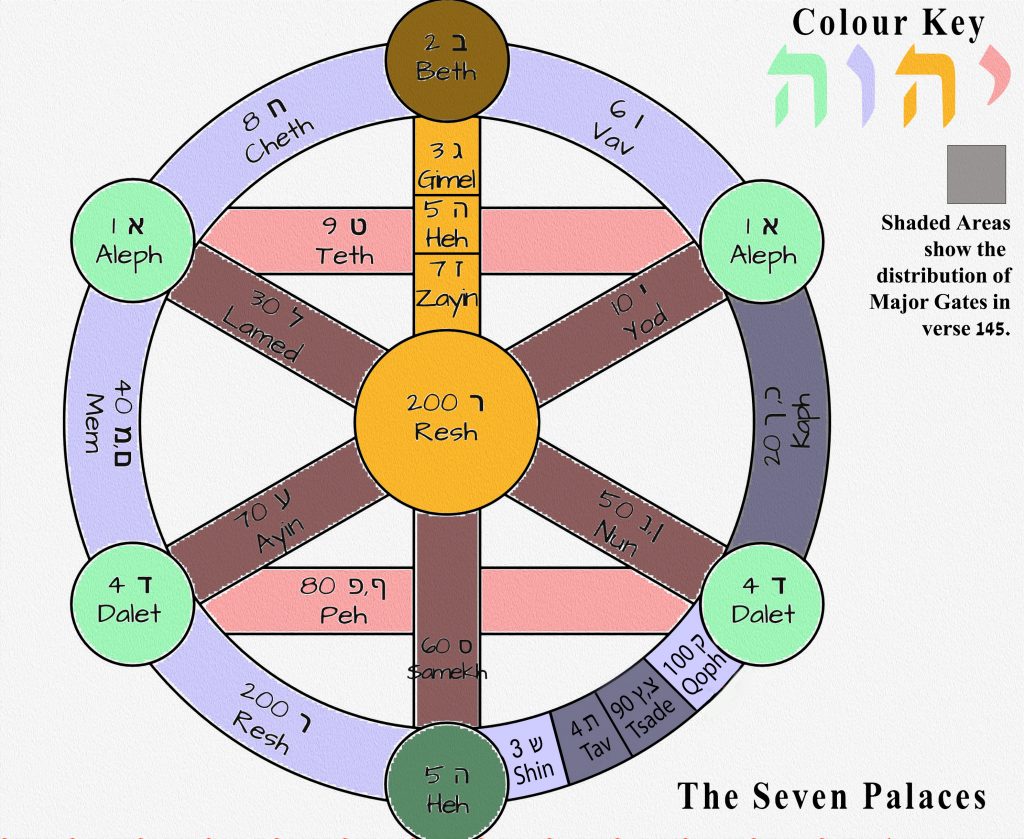
This is the gate number of the path between the Palaces of Beth and Resh when added to the Path of Samekh on the Seven Palaces.  The path of Samekh upholds the heavenly abode of YHVH.
Upholds (126).

Ayin (70)  Line 15:  The eyes (140) – the elect (61) + await you (221) = 300.
Like (75) + their food (91) + in season (82) = 248.
And you (16) + like (75) + their food (91) = 182.
All (50) + await you (221) – The eyes (140) – the elect (61) =  70.
And you (16) + give (110) = 126.

Peh  (80)  Line 16:  to all (80)
Open (98) = to all (80) + Living things (18) = 98
Your hand (34) + desire (346) = 380.
Open (98) + Your hand (34) – and satisfy (131) = 1
Desire (346) – To all (80) – living things (18) = 248.

Tsade (90)  Line 17:  Righteous (204)
In all (52) + His deeds (129) = 217.
His ways (240) – YHVH (26) – and kind (88) = 126
Righteous (204) – in all (52) – in all (52) + YHVH (26) = 126
Righteous (204) – in all (52) – and kind (88) + YHVH (26) = 90

Qoph (100)  Line 18:  Near (308) + call (322) = 630.
Those calling (317) – in truth (47) = 270.
630 – 270 = 360.
to all (80) + to all (80) = 160
360 – 160 = 200.

Resh (200)  Line 19:  The desire (346)
Of the fearful (227) + he will fulfill (88) + and will save (145) = 460.
Their cry (123) + he hears (123) = 246
346 – 246 = 100
460 – 100 = 360.

Shin  (3)  Line 20:  Preserves (249) + YHVH (26) + all (50) + those who love (24) – wicked (328) = 21 = 2 + 1 = 3.
YHVH (26) – those who love (24) = 2.
YHVH (26) + those who love (24) = 50.
Wicked (328) – all (50) – he will destroy (67) – YHVH (26) – all (50) – those who love (24) = 111 = 1 + 3 + 1 = 3.

Tav (4)  Line 21:  Incarnate (205) + name (43) = 248
To forever (176) + and ever (80) =  256
Praise (43) + YHVH (26) + will speak (216) = 285
And bless (238) – holy (113) + My mouth (90) = 215.
285 + 215 = 500.
248 + 256 + 285 + 215 = 1004 = Ath (with a large aleph).
To forever (176) + and ever (80) – all (50) =  206
Praise (43) + YHVH (26) + will speak (216) + my mouth (90) + and bless (238) + all (50) + incarnate (205) + name (43) + holy (113) + to forever (176) + and ever (80) = 1200.
1200 / 50 = 24.


4. Frequency and Analysis.

The 14 main gates of the Seven Palaces are; 9, 11, 11, 25, 45, 88, 206, 209, 211, 217, 231, 254, 265, 274.

The text contains 6 of these gate values and they occur 11 times:  206 (x 2), 209 (x 2), 217 (x 4), 231, 254, 265, in the paths of Beth, Heh, Yod, Kaph (x2), Lamed, Nun, Samekh, Ayin, Tsade, and Tav.  The path of the Resh represents the solar voyage across the land of the living and is the destination of the fortunate reincarnated soul.

The first 9 values of the letters through either straight gematria or calculation can be returned from the first 9 corresponding verses and is discovered sporadically 6 times after the Teth.

  1. ALVHI (God) 52 + King 95 + your Name 60 = 207
    I will extol (307) – 207 = 100.
    Forever (176) – everlasting (77) = 99
    100 – 99 = 1.  Aleph
  2. Every (52) + day (56) + your Name (60) = 168
    I will bless (243) – and praise (77) = 166
    168 – 166 = 2.  Beth
  3. And praised (111) = 1 + 1 + 1 = 3. Gimel
  4. To generation (240) – Generation (210) = 30
    And your mighty acts (251) – Your works (143) – shall praise (23) – declare (33) – 30 = 22
    22 = 2 + 2 = 4.  Daleth
  5. On the glorious (32) – shall I speak (27) = 5. Heh
  6. I shall declare (396) + and greatness (83) – they will say (257) = 222 = 2 + 2 + 2 = 6.  Vav
  7. Memory (227) – and of your righteousness (224) = 3.
    Great (202) + goodness (37) + they shall abundantly utter (98) – shall sing (316) = 21.
    21 / 3 = 7.  Zayin
  8. Slow (221) – to anger (131) – of covenant loyalty (82) = 8.  Cheth
  9. Over (100) + all (50) + his works (129) = 279.
    279 – and bringing mercy (270) = 9.  Teth
Verses with number sympathy for their letter.

and also from verses
Nun;  Faithful (141) + Elohim  (92) + Your works (224) =  362.
In Words (224) + And Kind (88) = 312.
362 – 312 = 50.  Nun
Ayin;  All (50) – await you (221) – The eyes (140) – the elect (61) =  70. Ayin
Peh;  to all = 80. Peh
Tsade;  Righteous (204) – in all (52) – and kind (88) + YHVH (26) = 90.  Tsade
And twice in Shin;
Preserves (249) + YHVH (26) + all (50) + those who love (24) – wicked (328) = 21 = 2 + 1 = 3.
Wicked (328) – all (50) – he will destroy (67) – YHVH (26) – all (50) – those who love (24) = 111 = 1 + 3 + 1 = 3.

The value for Resh (200) is found in the verse for Qoph (100) and vice versa; the value for Qoph is returned in the verse for Resh. Each verse also produces the value of 360 (which commonly represents the circle of 360 degrees in these calculations).  This is interesting because Qoph and Resh correspond to verses 23 and 24 of Genesis which is on the theme of interdependent generation and marriage:

Qoph 100‎.
‎23. The man said,‎
‎“This is now bone of my bones,
And flesh of my flesh;
She shall be called Woman,
Because she was taken out of Man.”‎

Resh 200‎.
‎24. For this reason a man shall leave his father and his mother, and be joined to his wife; and they shall ‎become one flesh. 25. And the man and his wife were both naked and were not ashamed.‎”

The value of 100 is also found in the verses Aleph, Teth, Yod, Mem and Nun.

The value 126 occurs in the text 7 times; once in the gematria of the verse for Samekh; with סוֹמֵ֥ךְ sowmek (which means ‘Upholds’) and a further 6 times in the calculations; in Aleph, Vav, Yod, Ayin and Tsade.  א + ו + י + ע + צ

סוֹמֵ֥ךְ sō·w·mêḵ:
bear up, establish, uphold, lay, lean, lie hard, put, rest self,

A primitive root; to prop (literally or figuratively); reflexively, to lean upon or take hold of (in a favorable or unfavorable sense) — bear up, establish, (up-)hold, lay, lean, lie hard, put, rest self, set self, stand fast, stay (self), sustain.

248  was returned 5 times in the analysis; in Vav, Zayin, Ayin, Peh, and Tav.

אַבְרָהָ֔ם – ‘Abraham’ (248);  His name was changed by God from Abram to Abraham.

When God originally makes the change of Abram’s name to Abraham (248) he gives his reason for the change by saying המון גוים נתתיך ‘of many nations I have made you’ = 248.  The gematria of the name and the explanation for it is a match.  248 is 8 x 31 (אל) and when the name of Abraham is magnified[8] by 10 (2480) then it is the total value of the two gates of the middle pillar of the Seven Palaces when the Beth is also magnified from 2 to 2000:
(Beth, Gimel, Heh, Zayin, Resh) 2215  + (Samekh + Resh + Heh) 265 = 2480.
248 is also the paths Cheth + Mem + Resh around the circumference of the Seven Palaces.

The number of Abraham’s name is a powerful and protective symbol to be woven into these verses of memorial.

שְׁלֵמָ֥ה + מַסָּ֖ע ‘made ready’ + ‘at the quarry’ = 248 (see 1 Kings 6:7).
הָא֖וֹר + הַחֹֽשֶׁךְ ‘the Light’ + ‘the darkness’ = 248 (see Genesis 1:4).

217  was returned 4 times in the verses for Beth, Heh, Lamed and Tsade.

217 is one of the most important gematria values associated with the Seven Palaces of El;
It is 7 x 31  = 217.
EL (God) = אל = 31.
It is the gematria number of the letters assigned to the Seven Palaces:  Beth + Aleph + Resh + Aleph + Heh + Daleth + Daleth = 217.
It is the gate number of the first Heh of YHVH; Beth + Gimel + Heh + Zayin + Resh = 217
It is the combined gate number of Cheth and the fourfold path (Shin, Tav, Tsade & Qoph).
It is the number of the order of the letters when Shin and Tav share 3rd and 4th place with Gimel and Daleth;
1 + 2 + 3 + 3 + 4 + 4 + 5 + 6 + 7 + 8 + 9 + 10 + 11 + 12 + 13 + 14 + 15 + 16 + 17 + 18 + 19 + 20 = 217.

It is the number of the ‘Holy Name’ and is thus the most powerful number to be evoked in memorial to the unknown deceased.

215  was also returned 4 times in Cheth, Yod, Samekh and Tav.  215 is similar to 217 but the 2 of the Beth is missing.  Therefore this number represents all of God’s creation apart from the Godhead itself.

The shaded areas mark the paths that total to 220.

207  usually represents ‘light’ (207) א֑וֹר, was returned 2 times from the verses of Aleph and Lamed (אל). The letters Aleph Lamed spells out El (God).  In verse 1 the scribe explicitly links the name of God (and King) to Light; ALVHI (God) 52 + King 95 + your Name 60 = 207 (Light).

48  was returned 3 times in Beth, Heh and Lamed.
Is a shortened version of 248.  It represents that paths of Mem and Cheth on the circumference and it is the value of the name ‘Moses’ (48) מֹשֶׁ֔ה and for דַּלְת֧וֹת  ‘Daltowt’ (48); the Doors, as well as כּוֹכָב ‘Kokab’ (48) meaning ‘star’.  Kochab and its neighbor Pherkad served as twin pole stars from 1500 BC until 500 AD, and ancient Egyptian astronomers dubbed them “The Indestructibles“.

360 was also returned 3 times in Yod, Qoph and Resh.  Circles tend to convey the notion of divinity or divine cycles in most ancient cultures.

Other values of interest include 410 (usually associated with לָרָקִ֔יעַ lā·rā·qî·a ‘to the firmament’ or ‘to the expanse’ (See Genesis 1:7) and is found in the verses for Kaph and Mem.  410 is the total number of the letters from door to door under the Seven Palaces (ד + ר + ה + ש + ת + צ + ק + ד);
220 which is the value of the first word of Genesis’ בראשית, and  טָה֑וֹר Tahowr’ (220); ‘Pure’ and also התורה ‘The Torah’ and is found in the verses for Gimel and Mem.  In the Egyptian Book of the Dead during the weighing of the heart ritual, the deceased says “I am pure, I am pure, I am pure, I am pure!”


5.  A Tour of the Afterlife...

The Seven Palaces.

  We’re going to take a tour around the afterlife in order to better understand Psalm 145 and what the scribe was trying to achieve by composing this work.  We’ll follow the path of the deceased and witness how the scribe seeks to deal with any difficulties the deceased may encounter on his road back to a new life.

The first station that the newly deceased crossed is the Palace of the Heh.  The Heh represents the most basic earthly plane as well as the most heavenly abode of YHVH, so there are two of them positioned on the Seven Palaces; the upper Heh (the first ‘Heh of YHVH) and the lower Heh (the last Heh of YHVH).  Verse 5 is actually the first verse where the scribe really speaks because it’s here that his magical workings begin with: “Honour (209) on the glorious (32) splendour (35) and works (222) of your wonder (201) shall I speak (27).”  According to tradition, the site of the Temple of Solomon was built at the Gate of this Earthly Palace, and its reputed to be the site that Adam and Eve emerged onto the earth after leaving the Garden of Eden.

Line 5:  Honour 209 + Splendor 35 = 244 (like Israel).
Honour (209) + splendour (35) – shall I speak (27) = 217
And works (222) – of your wonder (201) + shall I speak (27) = 48.
On the glorious (32) – shall I speak (27) = 5.

Because the phrase ‘shall I speak’ is subtracted from Honour and Spendour, this verse reminded me of the admonition “to be silent before the lord”;  “Be silent, all flesh, before the LORD; for He is aroused from His holy habitation.”  – Zechariah 2:13.

When the deceased cross this threshold they shuffle off their mortal coil and begin their journey to the Palace of the Daleth in the West.  Each Palace and path had guardians that allowed the worthy to pass but stopped the unworthy from continuing the road to reincarnation, so it was probably good council to guard your speech.  The scribe offers the number five for the Palace of the Heh, and then evokes the number of the holy name (217) as a pass to the next gate which has the combined gate of 217 with the Cheth in the heavens.

The Path to the Palace of the Daleth is the only one to be comprised of 4 letters; the Shin and the Tav, the Tsade and the Qoph.  It has a gate number of 206; seen in Kaph and Tav.  The letters Qoph, Shin and Tav spell out the word keshet for ‘Rainbow’ QShTh.

The Tsade has two seperate instances of 126 (upholds) possible, and the scribe again offers 217 for the combined gate and 90 for the letter Tsade.  The main theme of this letter is the praise of God:  In all (52) + His deeds (129) = 217.

This letter is associated with the earthly aspect of pregnancy and midwifery.  The Tarot card associated with the Tsade is the Emperor Caesar because of the legend that the Emperor was born by Caesarian Section.  The first act of reproduction is recorded in Genesis and it corresponds with this Tsade with this verse; “And caused to fall YHVH Elohim a deep sleep upon the Man and he slept and he took one of his ribs.  And made YHVH Elohim + the Rib that he had taken from the man to the woman and brought her to the man.” – Genesis 2:21-2. The deceased has got quite some way to go before he thinks of a new earthly body however; he’s got a rainbow to climb.

The letter Qoph may represent a test of the deceased.  By withdrawing ‘in truth’ from ‘those calling’ it results in the number for evil רָֽע) 270), but by calling on the aid of YHVH and speaking nothing but truth the deceased could pass on to the next leg of our tour. Once a day the Sun (Resh 200) would pass this way and fully illuminate the reflective Moon, and the worthy were allowed to ride along with the Sun to the Palace of the Daleth.

The letter Shin represents the fire of earthly heat that causes both dry land and the decomposition of a corpse alike.  The verse promises preservation for ‘those who love’ and destruction for the wicked and unworthy, but whatever your stripe your physical remains will break down into their essential elemental forms.  This letter represents this process but it also promises renewal; it is an important part of the cycle of biological life.

In Genesis 1, the corresponding verse for Shin reads:  “9. Then God said, “Let the waters below the heavens be gathered into one place, and let the dry land ‎appear”; and it was so. ‎ God called the dry land earth, and the gathering of the waters He called seas; and God saw that it ‎was good.”‎

To explain the Tav I’m going to read the corresponding verse of Genesis 1: 14 “Then God said, “Let there be lights in the expanse of the heavens to separate the day from the ‎night, and let them be for signs and for seasons and for days and years; 15. and let them be for lights ‎in the expanse of the heavens to give light on the earth”; and it was so. 16. God made the two great ‎lights, the greater light to govern the day, and the lesser light to govern the night.”

The letter Tav is all matter and all time, and the measurement of both.  The scribe offers 206 for the gate and evokes the mighty word of 8 x 31 so the deceased may proceed to the Palace.  The scribes ultimate offering is 1200 from the total sum of this verse.

Once the deceased arrives at the Palace of the Daleth its decision time.  If the deceased is found to be unworthy here, then they will evaporate into their spiritually constituent parts like mist by the power of the Kaph.  Kaph is like the heavenly version of the Shin in this respect.  On the other side of the Tree is the Mem emerging from the Aleph represents all things emerging from the one, but the Kaph connection to the Palace of the Aleph represents all things returning to the one.

 The path along to the other Daleth, which is re-entry and reincarnation, is along the path of Peh:  Open (98) plus (5) Your hand (34) and satisfy (131) to all (80) living things (18) desire (346).  However because this path is only open for all living things then the way of the deceased is barred.

“Open (98) = to all (80) + Living things (18) = 98”

The path of Peh involves the mysteries of fertility.  The theme of unsatisfied desires is confronted in the Genesis verses that correspond with the Peh:  “Then the LORD God said, “It is not good for the man to be alone; I will make him a helper suitable ‎for him.” 19. Out of the ground the LORD God formed every beast of the field and every bird of the sky, ‎and brought them to the man to see what he would call them; and whatever the man called a living ‎creature, that was its name. 20. The man gave names to all the cattle, and to the birds of the sky, and ‎to every beast of the field, but for Adam there was not found a helper suitable for him.”

Desire (346) – To all (80) – living things (18) = 248.

The only way left for the deceased to travel is along on the Path of Nun (corresponding to the Death card in the Tarot) towards the Sun.  The value of the Nun is 50, the same as האדם ‘The Adam’ and also מ֥וֹת ‘mowt’ which means ‘Death’ and יָם ‘Sea’.  The path opposite to Nun and influencing (or governing) it from above is Lamed.

The verse for Nun in the Dead Sea scrolls is not very helpful in assisting us to form a picture of what the deceased might face on this path.  “13b.  Faithful (141) Elohim (92) in words (224) and kind (88) in all (52) your works (129).”  The scribe made it possible to produce the 50 with the calculations:

Faithful (141) + Elohim  (92) + Your works (224) =  362.
In Words (224) + And Kind (88) = 312.
362 – 312 = 50 (Nun).
We can also find an 80 (which is Nun 50 + Lamed 30) from “In words (224) – Elohim (92) – in all (52)”; which addresses the influence from the Lamed upon this path (Nun + Lamed = 80).

The verse for Lamed is “To make atonement (125) to the sons of (92) the men (50) your mighty acts (231) and the majestic (38) splendor (209) of Malkuth (106)”.

Here, the scribe pulls out all the stops and densely packs the verse with protective numbers and gate numbers;
‘Your mighty acts’ (231) is the gate number of the Lamed (Aleph + Lamed + Resh), and splendor (209) is the gate number of the Resh associated with the Sun.  To make atonement (125) + To the sons of (92) = 217 for the holy name, and the values of 207 (light) and 48 (כּוֹכָב star/מֹשֶׁ֔ה Moses/דַּלְת֧וֹת the doors) are also discoverable in the calculations.  

The corresponding verse for the Nun in Genesis is:
“Out of the ground the LORD God caused to grow every tree that is pleasing to the sight and good ‎for food; the tree of life also in the midst of the garden, and the tree of the knowledge of good and ‎evil‎” (600).  The penalty that God threatened Adam and Eve with should they eat the fruit of the Tree of Knowledge was death, but first their souls had to be born on the earth.  It may be that the tempting fruit of the garden of Eden are all the sensual pleasures of incarnating into flesh itself.

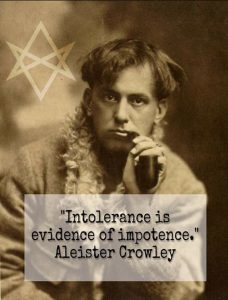
The corresponding verse for the Lamed in Genesis is:  “Then the LORD God formed man of dust from the ground, and breathed into his nostrils the breath ‎of life; and man became a living being.”  Aleister Crowley believed the Lamed was associated with the Goddess Ma’at therefore there may have been one last and final test of the deceased that was something like the weighing of the heart ritual (against the feather of Ma’at) here.  On the other hand it’s equally possible that the Hebrew tradition was distinctly different.  The theme of the verse is one of praise.
The next path is the Ayin and it runs from the Palace of the Sun to the Daleth on the left.  In the Tarot, this path is attributed to ‘the Devil’, but this is because of the Gnostic belief that the material world was somehow ‘evil’.  Originally however, this path represented the creative and fertile aspect of God that begets and engenders life. In the path of the Peh, the material aspect of the sexual act itself is symbolised by the Peh that passes between the two doors, but on the path of the Ayin the influence of the Yod is felt.  In Genesis the verses associated with the Ayin and the Yod are:

Yod  1. Thus the heavens and the earth were completed, and all their hosts. 2. By the seventh day God ‎completed His work which He had done, and He rested on the seventh day from all His work which He ‎had done. 3. Then God blessed the seventh day and sanctified it, because in it He rested from all His ‎work which God had created and made.‎

Ayin  5. Then the LORD God took the man and put him into the garden of Eden to cultivate it and keep it. ‎‎16. The LORD God commanded the man, saying, “From any tree of the garden you may eat freely; 17. ‎but from the tree of the knowledge of good and evil you shall not eat, for in the day that you eat from ‎it you will surely die.”‎

Ayin could be thought of as the path of temptation and desire leading to the ultimate fulfillment and satisfaction of God after his creative work which is represented by the Yod.

To Aleister Crowley the sexual connotations were obvious; the Yod represented spermatozoa and the penis spent and at rest, while the Ayin was the erect and potent forces of God in the appropriate season begetting the universe.  For Crowley the symbolism of the sexual act was everywhere found in fertility rituals.  In the Thoth tarot deck the figure of the Hermit is hooded and phallic.  He is slightly bent over and his hair bears an obvious resemblance to cum.

“Yod Phallus Spermatozoon HandLogos Virgin. There is perfect Identity, not merely Equivalence,of the Extremes, the Manifestation, and the Method” , ‘The Book of Thoth’, by Aleister Crowley.

The deceased, now confirmed as pure and fit for reincarnation is allowed to ride in the presence of God on his solar chariot until they reach the Palace of the Dalet and he deposits his load.  The Palace of the Daleth receives the blessings of God that emerges into the world as one; the solar fire and the souls of the departed (and now about to become reincarnated) as well as the seat of the consciousness of the material substance passing from the male to the female. From this door into the world, the consciousness of the deceased influences their new material body (represented by the Tsade) and after 248 days they are born anew under the Sun – in the Palace of the Heh and the cycle of death and life is complete.


6.  Conclusion.

Psalm 145 is not only an alphabetic acrostic; it is a very deliberately arranged composition that has been densely packed with gematria calculations.  While the text could perhaps be criticized for being rather prosaic in terms of ‘a good read’, there’s something rather more energetic, artistic and exciting happening on a numerical level.  Each verse has been composed as a numerical ‘spell’; designed to aid the deceased on their travels into the afterlife and provide some measure of protection for the righteous who will be reborn on the Wheel.


7.  Footnotes.

[1][5]  Evil and the Disruption of Order: A Structural analysis of the Acrostics in the First Book of Psalms [Pdf] by Ronald Benun.

[2]   The gematria of the Tanakh was composed with the Paleohebrew script.
Because Paleohebrew has no ‘final forms’ then any final letters in Ashuri are counted with the same value as ordinary letters.
All the values are exactly the same as ‘standard gematria’ except that the letter Shin = 3 (not 300) and the letter Tav = 4 (not 400).
Paleohebrew has 22 letters and 22 characters. Ashuri on the other hand has 22 letters and 27 characters so it can represent the numbers 1 – 900. When the number values from Paleohebrew were transposed to the Ashuri letters the Shin and Tav were multiplied to 300 and 400.

Most published gematria values contain this mistake (or blind). A clue is left in the names of the numbers themselves however that reflect the Resh was the last letter of the alphabet: each of the words for the gematria numbers (i.e. עֶ֣שֶׂר Ten, מֵאָ֥ה One Hundred, מָאתַ֔יִם Two Hundred) have a single word to denote them but this pattern breaks at Three Hundred, which has two words; שְׁלֹ֣שׁ מֵא֣וֹת Three Hundred – indicating that Three Hundred and Four Hundred were not primary values of the letters.

The values of the Shin and Tav are further confirmed as 3 and 4 by the gematria of the Seven Palaces which arranges the number set in a fashion that evokes combinations (gates) which can be used as a checksum; ב(2) + (8)ח + (1)א  +  (5)ה +  (3)ש + (4)ת + (90)צ + (100)ק + (4)ד = 217.

[3] Attributed to Rabbi Johanan Ha-Nappah in the 3rd Century CE.

[4] The word for ‘upright‘ is תְמִֽימֵי ṯə·mî·mê: which means without blemish, complete, full, perfect, sincerely, sound, without spot, undefiled. The word is from תָּמַם tamam; accomplish, cease, be clean passed, consume, have done, come to an end.
A primitive root; to complete, in a good or a bad sense, literal, or figurative, transitive or intransitive (as follows) accomplish, cease, be clean (pass-)ed, consume, have done, (come to an, have an, make an) end, fail, come to the full, be all gone, X be all here, be (make) perfect, be spent, sum, be (shew self) upright, be wasted, whole.

[6]  Gates are made by combinations of letters on the Paths and Palaces.  For instance; the path leading from the Palace of the Beth to the Palace of the Resh has 3 letters attributed to it; Gimel, Heh and Zayin: therefore the main ‘gate’ for this path is 217.  Opposite this path (the Samekh) the main gate value is 265.  When each is added to it’s opposite then a combined gate value is made (482).

[7] Please see ‘Confirmations of the Tree of Life’ and diverse other articles on this site for more information about the Seven Palaces.

[8] Multiplying the value of Abraham’s name is suggested by Genesis 12:2 “ואעשך לגוי גדול ואברכך ואגדלה שמך והיה ברכה
– “And I will make you a nation great and will magnify your name and you shall be a blessing.”

Filed Under: Aleister Crowley, Gematria, Merkabah Wheel, Tarot

Scientists of the Art – Artists of the Science

July 24, 2017 By BethSheba Ashe Leave a Comment

An eclectic collection of mixed media.


Shematria is a dedicated biblical gematria calculator.

Type in Hebrew, Greek or Roman or look up a number.
Works with Strong’s references.
Look up bible verses in Hebrew or Greek.
‘The Book of the Law’ by Aleister Crowley, now searchable.


Letter Symbolism and Merkavah imagery in the Zohar’ by Eliot R. Wolfson.


Living Thelema – Cognitive Therapy for Magicians (2012)
This track from episode 29 is from the Living Thelema series by Dr. David Shoemaker. This particular segment is about Cognitive Therapy for Magicians.


“Was deciphering the MDW NTR necessary to formulate the Ancient Hebrew Abjad?”

This is an excellent video lecture by ‘Divine Prospect’ (Ron Shields).  Discusses the work of Professor Douglas Petrovich as he traces the migration patterns of the Israelite people through the ancient near east.  Have a note book handy because DP gives you a lot of work to go and research for yourselves afterwards.


“Ancient Egyptian Calendars: How Many Were There?”
[Abstract]  “In 1950, Richard A. Parker hypothesized that pharaonic Egypt had three separate calendars: origi-nal lunar; civil; later lunar, of which the most ancient was the original lunar. l To be fair, it should be noted that Ludwig Borchardt first discussed the idea of a second lunar …”

Publisher: JSTOR
Publication Date: Jan 1, 2002
Publication Name: Journal of the American Research Center in Egypt 39: 241-250


Heaven on Earth: A Tour of Solomon’s Temple through Near Eastern Eyes [Video]

Victor Avigdor Hurowitz presented “Heaven on Earth:
A Tour of Solomon’s Temple Through Ancient Near Eastern Eyes.”


“Talking About Ritual Magick”

“This blog is used to discuss various issues and topics pertinent to ritual magick and ritual magicians as proposed by Frater Barrabbas Tiresius – author, witch and ritual magick practitioner.”


Is Quantum Physics Necessary for the Account of Consciousness? The Lecture of Stuart Hameroff

One of the most comprehensive lectures on the Orch OR theory of consciousness to date. It was held at the Moscow Center for Consciousness Studies in October 2016.

“The nature of consciousness, the mechanism by which it occurs in the brain and its place in the universe are unknown. In the mid 1990’s Sir Roger Penrose and I suggested that consciousness depends on biologically ‘orchestrated’ coherent quantum processes in collections of microtubules within brain neurons, that these quantum processes correlate with, and regulate, neuronal activity, and that the continuous Schrodinger evolution of each such process terminates in accordance with the specific Diosi-Penrose (‘DP’) scheme of objective reduction (‘OR’) of the quantum state. ‘Orchestrated’ OR activity (‘Orch OR’) is taken to result in moments of full conscious awareness and/or choice. The DP form of OR is related to the fundamentals of quantum mechanics and space-time geometry, so Orch OR suggests a connection between brain biomolecular processes and the basic structure of the universe. I will review Orch OR in light of criticisms, presenting experimental evidence for 1) hierarchical microtubule quantum resonances (terahertz, gigahertz, megahertz, kilohertz), and 2) anesthetics preventing consciousness through quantum actions on microtubules. Further novel Orch OR suggestions include 1) topological quantum bits (‘qubits’) intrinsic to microtubule geometry, 2) interference ‘beat frequencies’ of fast (e.g. megahertz) microtubule vibrations producing slower electro-encephalographic (EEG) correlates of consciousness, 3) mental state alterations caused by brain stimulation with megahertz mechanical vibrations (ultrasound), and 4) OR-based primitive feelings prompting life’s origin and evolution. Orch OR is rigorous, consistent with neuronal-level approaches and better supported experimentally than other theories of consciousness. Reference: Hameroff & Penrose (2014) Phys. Life Rev., 11(1):39-78”


“The Visions of Aleph” by Doctor T. (1797)‎.
Published in ‘The New York Magazine, Or Literary Repository’.


Author of mysterious Voynich manuscript was Italian Jew, says scholar.  – News feature from the Guardian.com

Illustrations of the book that has confounded code-breakers and scholars for more than 100 years may offer key clues about authorship


Chicago Library Seeks Help Transcribing Magical Manuscripts

Three texts dealing with charms, spirits, and all other manners of magical practice are now accessible online

Among the library’s collection of rare Bibles and Christian devotional texts are a series of manuscripts that would have scandalized the religious establishment. These texts deal with magic—from casting charms to conjuring spirits—and the Newberry is asking for help translating and transcribing them.”


 THE 100th MONKEY PRESS
Ex Scientia Adhevo Sapientia
– has an impressive collection of reproductions of the original works of Aleister Crowley.


Origins of the ancient constellations: The Mesopotamian Traditions. By John H Rogers.


THE BRAZEN SERPENT

A personal explication of the Thelemic Qabalah, by Soror N.’.O.’.


The Great Clock: -3- The Sirian Year

The Ancient Egyptians used a Sirian Year of 365.25 days which was neither the Tropical year of 365.242, or the Sidereal Year of 365.256 days. We explain the manner of discovering this unique astronomical cycle and go through some ideas about Sirius as a neighbor star to the Solar System.

“The fact is that Sirius is the only star in the night sky that is not affected by the precession of the equinoxes as the rest of the stars are. The Egyptians would signal their New Year’s Day when Sirius became visible again after about 70 days of absence in the night sky. As the Sun moved through the neighboring Zodiac constellations of Gemini and Cancer, Sirius would not be seen because of the bright sunlight in front of it by day, but as soon as the sun advanced around the year and entered Leo, Sirius became visible again. On the day when it became visible again, it would rise at morning right before the Sun in what is known technically as heliacal rising.

Right at the break of dawn, Sirius would become visible again after 70 days of invisibility for the ancient inhabitants of the Nile, and being the brightest of stars, it would appear over the horizon just before the Sun with a flash indicating New Year’s day for the ancient Egyptians. But why did they choose the heliacal rising of Sirius for their New Year?”


[Pdf] Beholders of Divine Secrets:
Mysticism and Myth in the Hekhalot and Merkavah Literature
by Vita Daphna Arbel

An examination “of the mystical notions present in the enigmatic Hekhalot and Merkavah literature, the manner in which these are expressed through mythological imagery, as well as the possible social-cultural and ideological affiliation of members of the Hekhalot and Merkavah mystical circle.”


[Podcast] from the Washington James Information School on the text ‘The exhalation of Inanna’.

“‎1-12. Lady of all the divine powers, resplendent light, righteous woman clothed in radiance, ‎beloved of An and Uraš! Mistress of heaven, with the great diadem, who loves the good headdress ‎befitting the office of en priestess, who has seized all seven of its divine powers! My lady, you are ‎the guardian of the great divine powers! You have taken up the divine powers, you have hung the ‎divine powers from your hand. You have gathered up the divine powers, you have clasped the ‎divine powers to your breast. Like a dragon you have deposited venom on the foreign lands. ‎When like Iškur you roar at the earth, no vegetation can stand up to you. As a flood descending ‎upon (?) those foreign lands, powerful one of heaven and earth, you are their Inana…”‎


Sumerian is the first language for which we have written evidence and its literature the earliest known.

The Electronic Text Corpus of Sumerian Literature (ETCSL), a project of the University of Oxford, comprises a selection of nearly 400 literary compositions recorded on sources which come from ancient Mesopotamia (modern Iraq) and date to the late third and early second millennia BCE.


 [Review]Reviewed Work(s): Sexual Symbolism and Merkavah Speculation in Medieval Germany: A Study of the Sod ha-Ezog Texts by Daniel Abrams
Review by: Joel Hecker
Source: The Jewish Quarterly Review,
Vol. 90, No. 1/2 (Jul. – Oct., 1999), pp. 202-206
Published by: University of Pennsylvania Press
Stable URL: http://www.jstor.org/stable/1455412

“Sod ha-Egoz, the Secret of the Nut, is an esoteric teaching with ancient roots that reached its fullest expression in Germany in the 12th-13th centuries. Emerging as an exegetical expansion on Song of Songs 6:11, I went down to the nut grove, the doctrine of the nut marks an early attempt by Jewish mystics of medieval Europe to speculate upon the divine chariot as imagined in the book of the prophet Ezekiel. In the various documents relating this mystery, the anatomy of the nut, with its shell, fruit, and various chambers, corresponds to the diverse aspects of the chariot. While speculation upon the chariot is a prominent theme in pre-kabbalistic and kabbalistic writings, its representation as a nut, an English or Persian walnut to be precise, is among its more novel expressions.”


Death and afterlife in Ugarit and Israel
By Elizabeth Bloch-Smith and Mark Smith

Abstract: “The background of the New Testament concepts of resurrection and afterlife has been studied intensively in the last two decades, largely under the impetus of the Ugaritic tablets from Ras Shamra. In the book under review, the author undertakes a comprehensive study of afterlife and “resurrection” in Northwest Semitic literature.”


The Use of the Hebrew Bible in Early Jewish Magic

“This study seeks to enumerate the extensive and variegated use of the Hebrew Bible in early Jewish magic. The survey focuses mainly on the key Jewish magical corpora from late antiquity and the early Middle Ages – Palestinian Amulets, Babylonian magic bowls, assorted magical texts from the Cairo Geniza, and several magical handbooks deriving from Babylonia and other indeterminate locations. The article is divided into three substantive sections. The first treats numerous methodological pitfalls tied to the use of the terms ‘magic,’ ‘Jewish magic,’ and ‘Hebrew Bible.’The second and third sections are devoted, respectively, to the two broad formal categories into which magical use of the Hebrew Bible may be divided, citations of biblical verses and biblical historiolae.”


LIEBERMAN, STEPHEN J. “A Mesopotamian Background for the So-Called Aggadic ‘Measures’ of Biblical Hermeneutics?”

Hebrew Union College Annual, vol. 58, 1987, pp. 157–225.


Genesis 1-11 and Its Mesopotamian Problem

Cultural Borrowings and Ethnic Appropriations in Antiquity, ed. E. Gruen (Stuttgart: Franz Steiner Verlag, 2005), pp. 23-36.


The Micro-Zodiac in Babylon and Uruk: Seleucid Zodiacal Astrology,
“Abstract: in ed. J. Steele, The Circulation of Astronomical Knowledge in the Ancient World, 2016.”


“When God Abandoned the Garden of Eden: A Forgotten Reading of Genesis 3:24“, Vetus Testamentum, 2015

Abstract
“Genesis 3:24, the final verse in the Eden Narrative, states that God stationed “the cherubim and the spinning-sword-flame” east of the garden of Eden, from which he had recently expelled Man. Or so it does in its masoretic version. Four Targumim, however, reflect an ancient, divergent vocalization of the verse’s fourth word. In this vocalization, the verse must be read as stating that God himself settled east of the garden. This divergence profoundly affects the meaning of the entire Eden Narrative. The targumic reading is grammatically and stylistically sound, and, conceptually, it fits well in the verse’s textual setting. Moreover, a deliberate alteration from it to the masoretic reading would fall squarely into an independently identified pattern of theologically-driven changes in vocalization. The targumic reading may therefore be closest to the original authorial intent.”

Dhamma Talks, by Luang Por Munindo.  Weekly readings for the Aruna Ratanagiri Buddhist Monastery, Northumberland, UK. 

 Translations of the Zohar: Historical Contexts and Ideological Frameworks, Boaz Huss.
Abstract
 The Zohar, a compilation of Kabbalistic texts which were written in the late thirteenth and early fourteenth centuries, was bestowed an authoritative and sacred status in many Jewish communities. Together with its central role in Jewish culture, the Zohar stimulated considerable interest in Christian Kabbalistic and Western esoteric circles. In recent years, a newly awakened interest in the Kabbalah and the Zohar has been evident in many circles both in Israel and all over the world. The interest in the Zohar stimulated its translation into different languages, each created according to different motivations and within diverse theological and ideological frameworks. This article offers a review of the history of translations of the Zohar and discusses the historical contexts and ideological frameworks in which these were created.

 Don Karr’s Bibliographic Surveys    –   Updated 1st. May 2017

The “Baphomet” of Eliphas Lévi:
Its Meaning and Historical Context
“It has been shown that the notion of synthesis and harmony that underlies Lévi’s Baphomet can only be comprehended against the background of the socialist doctrines he articulated in his writings of the 1840s.”

THE SCIENTIFIC COMPATIBILITY AND UNIQUENESS
OF HEBREW COSMOLOGY 
AMONG ANCIENT NEAR EASTERN LITERATURE
By Joe Miller

The Priestly Account of Building the Tabernacle
Victor Avigdor Hurowitz

Origins of the Alphabet, by Orly Goldwasser 2015.

Cultural and Religious Impacts of Long-Term Cross-Cultural Migration Between Egypt and the Levant, in Journal of Ancient Egyptian Interconnections 12, 2016, 50-88.  

Thomas Staubli
University of Fribourg, Swizerland
ABSTRACT
“An increase of cross-cultural learning as a consequence of increased travel and migration between Egypt and the Levant during the Iron Age occurred after millennia of migration in earlier times. The result was an Egyptian-Levantine koine, often not recognized as relevant by historians due to an uncritical reproduction of ancient myths of separation.However, the cultural exchange triggered by migration is attested in the language, in the iconography of the region,in the history of the alphabet, in literary motifs, in the characterization of central characters of the Hebrew Bible and,last but not least, in the rise of new religions, which integrated the experience of otherness in a new ethos.”

[Pdf] ‘Faces of the Chariot’ by David Halperin.

The Circulation of Astronomical Knowledge in the Ancient World.

Review: “NEW-ANCIENT WORDS” AND NEW-ANCIENT WORLDS
Reviewed Work(s): The Zohar: Translation and Commentary, 2 volumes. Pritzker edition.Vol. 1, Vol. 2 by Daniel C. Matt; A Guide to the Zohar by Arthur Green  
Review by: Joel HeckerSource:  Hebrew Studies,
 Vol. 47 (2006), pp. 403-431Published by: National Association of Professors of Hebrew (NAPH)Stable URL: http://www.jstor.org/stable/27913811Accessed: 24-12-2016 00:35 UTC

 Pleiades in Ancient Mesopotamia

Lorenzo Verderame
”Sapienza” Università di Roma
“In this paper I will analyse the different features of the Pleiades in the astronomical, astrological, andcalendrical interpretation as well as their mythical and cultural background in ancient Mesopotamia.According to cuneiform sources, the Pleiades are among the most important stars. They are simply known in Sumerian as ―the Stars‖ (MUL.MUL), while their Akkadian name, ―the Bristle‖ (zappu), links them to the imagery and the cultural context of the ―Bull of Heaven‖ constellation (Taurus), to which they belong.  Pleiades are frequently depicted as seven dots or seven stars, and identified on a mythological level with
groups of seven divine beings. In fact, the Sumerian ideogram for ―seven is used as an alternative name for the Pleiades.”

Text and Context in Biblical Studies A Brief History of a Troubled Relationship, by Steven Weitzman.

2016. Sass B. Aram and Israel during the 10th–9th centuries BCE, or Iron IIA. The Alphabet. In O. Sergi, M. Oeming and I.J. de Hulster eds. In search of Aram and Israel. Politics, culture and identity (Orientalische Religionen in der Antike 20). Tübingen, 199–227.

FUTHARK RUNES, GREEK MYSTERIES & ALCHEMICAL ALPHABETS
A paper looking at the alphabet;
from its paleo-Hebrew beginnings to the Futhark Runes of Northern Europe, by Judith Dillon.

Elusive Scrolls: Could Any Hebrew Literature HaveBeen Written Prior to the Eighth Century  BCE?

by Matthieu Richelle

 (2016) The Early History of the Alphabet: An Open Response to Christopher Rollston, by Douglas Petrovich.

The Early History of the Alphabet and the Recent Claim that the Northwest Semitic Inscriptions from Serabit el-Khadm and Wadi el-Hol are Hebrew: Spoiler Alert, They’re Not. by Christopher Rollston.

Comments on the Historical Background of the Abraham Narrative

Between “Realia” and “Exegetica” – Israel Finkelstein/Thomas Römer.

Cogito – A short film by Russell W.B Kirkby
Tag Line: “How do you know what you think you know?

A man narrates his personal deconstruction of his reality as he journeys to an audition to discovers that he is an actor auditioning for the film he is already in.
“A post modern interpretation of Descartes Meditations.”


The Hebrew Names of the Seven Planets, by Robert R. Stieglitz.


 “Did I Not Bring Israel Out of Egypt?” 

 Biblical, Archaeological, and Egyptological Perspectives on the Exodus Narratives.

 A comparison of the Seven Seals in Islamic esotericism and Jewish Kabbalah, by Lloyd D. Graham.
“In Islamic mysticism and theurgy, the Seven Seals represent in graphic form the Greatest Name of God; in Jewish Kabbalah, the Seals bear individual Divine Names which collectively form a “Great Name.” We review and compare the primary interpretations and secondary associations for each Seal in Islam and Judaism, from which it is clear that the two traditions have developed largely independent understandings of the individual symbols. Nevertheless, points of convergence – such as the interpretation of the fourth Seal as a ladder and an ascent to/of goodness – do exist. Conversely, the attributes of the third Islamic and seventh Jewish Seals have a surprising amount in common.”

Greek Coptic and Jewish Magic in the Cairo Genizah, by Gideon Bohak  – BASP 36, 1999

 Biblehub – for all your interlinear necessities – featuring topical, Greek and Hebrew study tools, plus concordances, commentaries, dictionaries, sermons and devotionals.

Jacob-El in the land of Esau and the roots of biblical religion, by Israel Knohl – Yehezekel Kaufmann Professor of Bible Studies, The Hebrew University, Jerusalem.  

“Lon Milo Duquette discusses Ceremonial Magick, the Tarot, Thelema, Aleister Crowley, Rituals, Philosophy of Ordo Templi Orientis, what the term “Do What thou Will is the Whole of the Law” means within Thelema. The Book of the Law, The Book of Thoth, Occult meaning of As Above, So Below. Satan, Lucifer, Baphomet,The moon child and Making of the Antichrist.”

Published on Jan 16, 2017


Why the Golden Dawn is Closer to Martinism than You Think And the Key to the Third Order Diagrams of the Golden Dawn, by Samuel Robinson, July 2017.

‘Aleister Crowley e a contracultura’ by Vitor Cei Santos.  [Portuguese]

ABSTRACT: “The main objective of this article is discussing Crowley´s doctrine of the New Aeon, thinking about its historical constitution, its values and consequences to the postmodernism. The occultist was a mythical and controversial writer, poet of the unrestricted freedom and of the will as a maxim sovereign, besides being a defender of the use of sex and drugs to magical purposes. His esoteric discourse stimulated existential trajectories of great refutable power, making him the counterculture guru.””


 Esoclassics Plus.  

90 books, pamphlets, documents, conferences, letters, etc. including the Sepher Bahir, The Egyptian Book of the Dead, and the Magical Ritual of the Sanctum Regnum.


 Evil and the Disruption of Order: A Structural analysis of the Acrostics in the First Book of Psalms, by Ronald Benun.

“Stellarium is a free open source planetarium for your computer. It shows a realistic sky in 3D, just like what you see with the naked eye, binoculars or a telescope.”  It is being used in planetarium projectors. Just set your coordinates and go.


The International Collection of Digitized Hebrew Manuscripts.

“With the rapid advances in the technological environment that significantly expand options for preservation, presentation and access to digital content, the National Library of Israel initiated the renewal of its collection of copies of Hebrew manuscripts. This enterprise, undertaken in partnership with the Friedberg Jewish Manuscript Society (FJMS) is designed to make Jewish manuscripts widely available. The International Collection of Digitized Hebrew Manuscripts will enable global centralized digital access to the complete corpus of existing Hebrew manuscripts. The images will be preserved long-term using state of the art technology, and the collection will be accessible to international communities of researchers and users from the comfort of their own institutions and homes.

The International Digital Library of Hebrew Manuscripts is made possible through the generous support of the Friedberg Jewish Manuscript Society (FJMS) and the Landmarks Heritage Program in the Prime Minister’s Office, created to preserve national heritage.”


Between Mesopotamia and Qumran: Cuneiform Literature and Jewish Aramaic Texts of the Second Temple Period

Author Bio:  Henryk Drawnel is Professor of Second Temple Literature and Jewish Studies in the Biblical Studies Institute at the John Paul II Catholic University of Lublin, Poland. His published works include articles and monographs on the Qumran Aramaic texts, including An Aramaic Wisdom Text from Qumran: A New Interpretation of the Levi Document (Brill, 2004) and The Aramaic Astronomical Book (4Q208-4Q211) from Qumran: Text, Translation, and Commentary (Oxford, 2011).


Jewish Worship, Pagan Symbols:
Zodiac mosaics in ancient synagogues.

Walter Zanger   •  06/09/2017


Reader’s Guide to Judaism – See page 457!

A concise set of notes on Gematria, the Merkabah and the Torah.

Who Maketh the Clouds His Chariot: The Comparative Method and the Mythopoetical Motif of Cloud-Riding in Psalm 104 and the Epic of Baal, by Jordan Wesley Jones (2010).

Abstract

Alleging parallels between Scripture and other ancient Near Eastern texts has always been a matter of controversy. The controversy has resulted from criticism of the comparative method by those who accuse its users of being overly simplistic or reckless when applying their particular approaches to the texts. This recklessness has resulted in alleged connections that are now considered very loose, unjustified, and harmful to the context of Scripture. In order to avoid the dreaded “parallelomania” that has resulted from hasty conclusions in comparative studies, it is necessary to approach alleged comparative units in a more concrete fashion, synthesizing the best of past approaches and cautiously utilizing those approaches when arriving at conclusions. The comparative element under discussion in this paper is that of divine cloud-riding, and the texts under consideration are Psalm 104:3 and the Ugaritic Epic of Baal. Both the Hebrew Bible and the Ugaritic texts describe Yahweh/Baal as a rider of the clouds. The mythopoetical motif of cloud-riding can be seen in many ancient Near Eastern texts where a storm god races through the heavens on his or her angelic cloud-chariot. This is true also of portions of the Hebrew Bible that describe Yahweh as one “who makes the clouds his chariot, who walks on the wings of the wind” (Ps 104:3). Since Ugarit is, in literature, Israel’s most significant Canaanite neighbor, it becomes a matter of interest when Baal is called repeatedly “the Rider of the Clouds” in his respective texts. Is there a legitimate parallel between the Yahwistic motif of cloud-riding and the northern Canaanite expression “Rider of the Clouds”? If so, what is to be made of this parallel and what were the psalmist’s intentions by including Baal-like language in his description of Yahweh?


The Brazen Serpent by Helen Kirby.

Published by Nephilim Press.

“In The Brazen Serpent, Helen Kirkby offers a far-reaching and thoughtful exploration of the philosophical, psychological and practical aspects of the Qabalah. Keep an eye on this promising new author!”

—David Shoemaker, author of Living Thelema, The Winds of Wisdom and other writings

The Brazen Serpent is an advanced treatise on the Hermetic Qabalah from a unique Thelemic perspective. It is NOT a beginner’s guide. The Brazen Serpent expects the reader to be familiar with the Thelemic paradigm and have working knowledge of the Tree of Life.


Red Flame; A Thelemic Resarch site

A website about Grady Louis McMurtry’s branch of the Argentium Astrum.

Filed Under: Uncategorized

Conformations of the Tree of Life

July 23, 2017 By BethSheba Ashe 1 Comment

“…Such an one is that man who ‎can neither institute the union of the Holy Name…” – The Book of Concealed Mystery.

The Tree of Life – showing Malkuth being added to Yesod – Portae Lucis, Augsberg 1516.

The Seven Palaces were hidden under the cipher of the Tree of Life and finding them required a student that was curious enough to ask themselves “I wonder what the original conformations of this diagram looked like?”

The first picture to be published of the Tree of life that wasn’t just a series of concentric circles, ‎was featured on the front cover of the Portae Lucis magazine in 1516[1].

Within a few centuries – new versions of the Etz haChayim (עץ החיים) [The Tree of Life] were popping up across Europe.  New paths were added to the Tree or the positions of the paths were altered.  Sometimes entire Sephiroth were added – no matter what the Sepher Yetzirah said[2]. Issac Luria and other later Kabbalists put much effort into this hermeneutical past-time, and they were joined by Western Occultists such as Frater Achad. These students redistributed the letters into something that was more pleasing and attuned to their personal view of the cosmos.

In it’s own private sphere this is a worthy inquiry if it assists the student to understand themselves somewhat better, but that isn’t the only motivation that people have when they start tweaking at the tree.  The Zohar contains an admonition in the ‘Book of Concealed Mystery’ that says “…derive the Supernals[3] into the position required…“ which is an open invitation to change the tree.

Notice that only one ‘position’ is mentioned. The word ‘position’ is not a plural, and Da’ath is not a Sephiroth, but ‘the position’.

The Seven Palaces – 5th knowledge lecture – The Complete Golden Dawn. Bill Heidrick noted the Golden Dawn diagram “This is the traditional depiction of the moment of the opening of the 50th Gate of Understanding, although there is little evidence that the matter was understood by the G.’. D.’. as such.”

When the supernals are combined in the position of Da’ath then the top half of the Seven Palaces are seen. When Malkuth is drawn back up into Yesod then all the Seven Palaces can be seen.

The Seven Palaces were hidden[4], and finding them required a student that was curious enough to ask themselves “I wonder what the original conformations of this diagram looked like?”  The first step in solving any really good puzzle or riddle is to take yourself out of the equation completely.  It’s not about what you think: it’s about what the writer means.  In a sense, it is a spiritual test… *to see* the Merkabah you have to first leave your ego at the door.

Students of the Golden Dawn had a slightly easier time of finding the original conformation of the Tree of Life because a picture of the Seven Palaces was given to initiates with their fifth knowledge lecture.  It’s a starting point but this diagram is devoid of any paths running between the palaces and it was mis-attributed as “the Seven Palaces of Assiah” (the lowest of the Kabbalistic four worlds).  Essentially the Golden Dawn lumped the Seven Palaces into the same category as the Qlippoth, without taking into account the ancient near east view of the cosmos with its Seven Heavens, Seven Earths and Seven Hells.

The idea of seven heavens originated in ancient Mesopotamia.  Sumerian incantations of the late second millennium BCE make references to seven heavens and seven earths. One incantation is: “an-imin-bi ki-imin-bi” (the heavens are seven, the earths are seven) and the Hebrew word for “heavens” was Shamayim (שָׁמַיִם 93).

What are the ten kings? They are the seven voices and three sayings (Amarim). – The Bahir.

To really comprehend the origin of the Tree of Life, you have to be a bit of a sleuth on an investigation – rather than an inventor at the potters wheel.  In a sense, you have to attack both the Torah and the Zohar as if they were cryptic crossword puzzles; analyzing every word to see if it has a second meaning.  Unlike a cryptic crossword the sources themselves require investigation and this can be especially difficult with translation.  Even the recent Pritzker edition has been ‘corrected’ with the Aramaic word for ‘Supernals’ having been replaced with another one for ‘Spheres’.

The Seven Palaces
The Seven Palaces

The phrasing of the full Zoharic admonition itself is a barrier to understanding;

“‎11. But what is to be understood by that ‎passage
“And they that despise Me shall be ‎lightly esteemed?”
Such an one is that man who ‎can neither institute the union of the Holy Name,
nor bind together the links of truth,
nor derive ‎the supernals into the position required,
nor ‎honour the Name of his Lord.
Better were it for ‎that man had he never been created,
and much ‎more for that man who doth not attentively ‎meditate when he saith Amen!”

– Chapter III – ‎Verse 11, ‘Kabbalah Unveiled’.

The line “and they that despise me shall be lightly esteemed” is lifted from Samuel 2:30 and it reads:

“Therefore the LORD God of Israel declares,
I did indeed say that your house and the house of your father should walk before Me forever;
but now the LORD declares,
‘Far be it from Me – for those who honor Me I will honor,
and those who despise Me will be lightly esteemed.

The theme of honour is repeated later in the verse; “…nor ‎honour the Name of his Lord…” but the word ‘honour’ in Samuel is מְכַבְּדַ֥י while the word used for ‘honour’ in the Zoharic verse is ‘הדר‘ which (according to Strong’s concordance) also carries the meanings of ‘to honor, adorn, and perhaps also ‘to swell’.   The word comprises three letters that appear on four of the seven palaces (the daleth appearing on two palaces).

In Deuteronomy the word ‘honour’ הדר is used in a very different context:  בכור שורו הדר ל֗וֹ  “As the firstborn of his bull honour to“, which makes a fascinating link with the bull god.  הדד ‘Hadad’ was the bull god son of the supreme Father of the Gods and creator deity אל El (31) and the three letters of the lowest Palaces form his name.  According to the Ba’al cycle texts found at Ras Sharma from Ugarit (6000 BCE – 1190 BCE)- Hadad lived in the Seven Palaces of his Father.

The next line of the riddle is “Such an one is that man who ‎can neither institute the union of the Holy Name.”  At the top of this page you’ll see a diagram that illustrates how – when the letters of the Seven Palaces are correctly attributed to the right Paths and Palaces; they coalesce to form values that are identical to the names of ancient biblical deities and major characters in the narrative. When placed in a logographic arrangement the numbers of the Seven Palaces recur and reflect around the structure.  For example:

Biblical Gematria

7 x 31 = 217.
2 + 3 + 5 + 7 + 200 = 217.
2 + 1 + 200 + 1 + 5 + 4 + 4 = 217.
197 + 20 = 217.
(5 + 3 + 4 + 90 + 100 + 4) + (2 + 8 + 1) = 217

200 + 40 + 8 = 248
217 + 31 = 248.

5 + 3 + 4 + 90 + 100 + 4 = 206.
217 – 11 = 206.

One cannot help but come away from a mathematical enquiry of the Seven Palaces, thinking that the interplay of the numbers upon each of the faces – with each depending on the others for support and existence – conveys a sublime insight into the interdependent functioning of the cosmos.

“…bind together the links of truth…“

What are the links of truth…?  One word for ‘link’ may be ‘qarse’ קַרְסֵ֥י with the value 370:
ועשית קרסי נחשת חמשים והבאת את־הקרסים בללאת וחברת את־האהל והיה אחד – Exodus 26:11.
“And you shall make 50 bronze clasps and put the clasps into the loops and couple together the tent that it may be one.”

Another word for ‘link’ might be עֲנָ֖ק Anaq (220) chain; a necklace, which shares its value with words such as ‘HaTorah’ and ‘Bereshith’, as well as with an arrangement of five of the six ‘inner paths’ that connect with the centered palace of the Resh.  These five paths never change their placement when the Tree is reformatted into the Seven Palaces.  They remain right where they are.  However the sixth path to connect with the Palace of Resh (from the Beth) is made of paths that were once connected to the three Supernals, and just as the Supernals went to make one Palace above, the connecting paths are bound together to make one interconnecting path comprised of the letters ג Gimel ה Heh and ז Zayin.

“50. We have learned (Proverbs 25:2), “The glory of God is to hide a word.”
What is “a word”? That of which it is written (Psalm 119:160), “The Beginning of Your
word is truth.”  [It is also written] (Proverbs 25:2), “It is the glory of kings is to research a word.”
What is this “word”? That of which it is written (Proverbs 25:11), “A word spoken in its
proper place (Aphen-av)”, do not read “its proper place” (Aphen-av), but “its wheel”
(Ophen’av)” – The Bahir.

Insight into how to arrange the letters from the lost paths of the Tree and onto the palaces are given in a Zoharic essay ‘The Mysteries of the Alphabet’.  In this narrative, God is deciding on what letter to begin the creation of the world with, and eventually he decides to begin with the letter Beth, yet he calls to the Aleph twice “Aleph!  Aleph!” and declares that his influence upon the earth shall only be expressed through the Aleph.  This is why the Beth is to the Seventh Palace (at the top) and the Alephs flank it on the palaces at either side.  The Bahir adds this insight into the location of the Daleths upon the Palaces:

“36. His students asked: Why is the letter Daleth thick on the side?
He replied: Because of the Segol which is in the small Patach.
It is thus written (Psalm 24:7), “The openings (pitchey) of the World.” There He placed a
Patach above and a Segol below. It is for this reason that it is thick.
37. What is the Patach? It is an opening (Petach).  What is meant by an opening? This is the direction of north, which is open to all the world. It is the gate from which good and evil emerge.” – The Bahir.

Daleth means ‘door’ – and the two doors on the Palaces are the Doors of Light and Darkness; Life and Death. Between the Palaces of the Doors is the Path of Peh, which begins the words ‘Petach’ and ‘Pitchey’.

A careful study of the Tanakh throws up a wealth of commentary on the conformations and qualities of the Seven Palaces.  Ezekiel is especially forthcoming about the conformations of the Seven Palaces.  For instance in Chapter 44:1-3:

1  Then He brought me back by the way of the outer gate of the sanctuary, which faces the east; and it was shut. 2  YHVH said to me, “This gate shall be shut; it shall not be opened, and no one shall enter by it, for the YHVH God of Israel has entered by it; therefore it shall be shut. 3  “As for the prince, he shall sit in it as prince to eat before YHVH; he shall enter by way of the porch of the gate and shall go out by the same way.”

[This means that no-one may may exit life via the same gate they were born (through the Palace of the Daleth in the East).  The ‘porch’ is the path of Peh – which was represented at the temple by a porch, and ‘the Prince’ is ‘Hadad’ (son of El) who lives in the Palaces of his Father according to the Ba’al cycle texts.]

Scattered among the early Kabbalistic texts, there are plenty of cryptic aids to assist in the discovery of the Seven Palaces. Unfortunately there have been few students who are even aware that they should have been looking for them.  Aleister Crowley was a different sort of man, and from his time with Scottish freemasonry he was quite clear that he should know about them.   From his accounts in ‘The Confessions of Aleister Crowley’ we can date the time of his discovery of the Seven Palaces to 1900.  His accounts make it explicitly clear that he was searching for the ‘Lost Word’ of the Freemasons; the word that was reputably only spoken by the High Priest within the presence of God in the tabernacle, and only once a year.

It’s fascinating that Crowley chose the verse he did to prove his assertions to knowledge of the Lost Word.  He gives an example from Genesis 17:5 – a verse that corroborates biblical gematria when shin = 3 and tav = 4 (as it does on the Seven Palaces).  ‘Abraham’ = 248 and המון גוים נתתיך “of many nations I will make” = 248.  By ‘standard’ gematria the sum total of המון גוים נתתיך is 1040.  It’s one of the rare examples in the Torah where the text directly verifies the gematria result.

“This exegetical method is not a modern invention.  When Jehovah selected a family to be the father of Israel, he changed the name (אברם (243 = Abram Father of Elevation into (אברהם (248 = Abraham Father of a multitude; and by way of compensation changed (שרי (510 = Sari Nobility to (שרה (505 = Sarah, Princess. There are several other similar stories in the Bible. A change of name is considered to indicate a change of nature.  Further, each name is not arbitrary; it is a definite description of the nature of the object to which it is attached. By a similar process, I am certain of my results in the matter of the Lost Word, for the Found Word fulfils the conditions of the situation; and furthermore, throws light on the obscure symbolism of the entire ritual.”

By 1904 he was using the gates of the Seven Palaces as a checksum for the riddle of Liber Al vel Legis and thereafter he keyed (or otherwise based) several of his best A.’.A.’. works to the Palaces – in effect creating a hidden system for the Inner Order of the A.’.A.’. and hiding the whole thing in plain sight.

It can be successfully argued that Aleister Crowley was just the latest of a long line of people who have attempted to create a systematic approach to initiation, but at least he had the virtue of of fully understanding the basis of the older system before he set out to create a new vehicle.


[1] The Tree of Life – showing the number ten being added to Yesod – by Paulus Ricius, Portae Lucis, Augsberg 1516.
[2] “Ten are the numbers, as are the Sephiroth, and twenty-two the letters, these are the Foundation of all things…[]…Ten are the numbers of the ineffable Sephiroth, ten and not nine, ten and not eleven. Learn this wisdom, and be wise in the understanding of it, investigate these numbers, and draw knowledge from them, fix the design in its purity, and pass from it to its Creator seated on his throne.” – 1:2-4, The Sepher Yetzirah.
[3] The Supernals are the top three Sephiroth of Kether, Chokmah and Binah.
[4] The Seven Palaces are at the core of Merkabah literature and Judah the patriarch forbade people to speak about Merkabah to one another.  Kabbalah came about largely in response to this prohibition upon free study; as a consequence the Seven Palaces was derived into the Tree of Life so that students could discuss the Merkabah in an enciphered fashion.

Filed Under: Gematria, Merkabah Wheel Tagged With: Aleister Crowley, Golden Dawn, Kabbalah, Merkabah, Portaelvcis, Seven Palaces, Tree of Life, Wheel

  • « Previous Page
  • 1
  • …
  • 4
  • 5
  • 6
  • 7
  • Next Page »

Copyright © 2025 · BethSheba Ashe · Log in